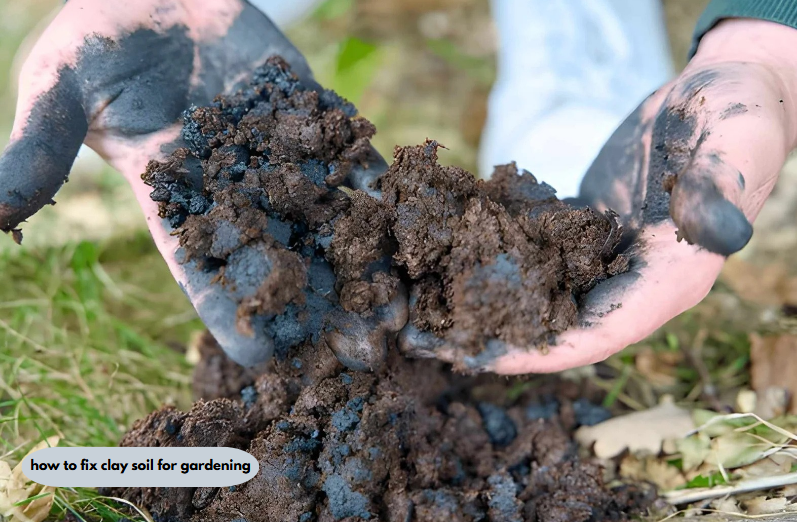
Here is how to fix clay soil for gardening: add 2 to 3 inches of compost each year, keep the surface mulched, and never dig or walk on it wet. Cover crops, raised beds, and deep-rooted plants speed the change, while sand and gypsum rarely help.
Key Takeaways
- Organic matter is the only amendment that permanently improves the structure of ordinary clay soil.
- A 3-inch compost layer over 1,000 square feet takes about 9.3 cubic yards of material.
- Digging or walking on wet clay presses it into hard clods that can last a full season.
- Gypsum helps only sodium-damaged soils, and small amounts of sand make clay denser, not looser.
- A lab soil test reports organic matter, pH, and sodium, which tells you exactly which amendment your clay needs.
What is clay soil?
Clay soil is ground dominated by mineral particles smaller than 0.002 millimeters, which pack tightly, hold water, and shrink into hard blocks as they dry.
That tight packing hides a strength. Clay holds far more nutrients than sand, so once its structure opens up, it often becomes the most productive ground on the property. That slow drainage affects more than planting beds. Patios and paths on clay also need a deep gravel base, as covered in our guide to building outdoor living areas on heavy soil.
How can you tell if you have clay soil?
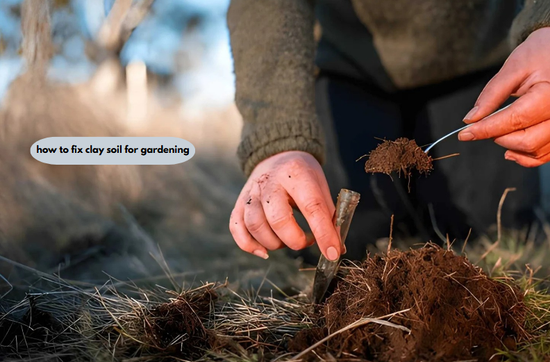
A moist handful that squeezes into a smooth, sticky ribbon longer than 2 inches is clay-dominated. Run these checks before you buy any amendment.
- Ribbon test: Roll damp soil between thumb and forefinger. A ribbon over 2 inches signals heavy clay, while one that snaps before reaching 1 inch points to loam.
- Drainage test: Dig a hole 12 inches deep, fill it with water, let it empty, then refill it. A water level that drops less than 1 inch per hour confirms slow, clay-heavy drainage.
- Jar test: Shake a cup of soil in a quart jar of water with a teaspoon of dish soap. Sand settles within a minute, silt within a few hours, and clay keeps the water cloudy for a day or longer.
- Lab test: Mail a sample to your state’s land-grant university lab. The report lists organic matter, pH, and sodium, the three numbers that decide which fix comes next.
The KDAGardenation Guide treats the spring drainage test as the deciding check. A hole that still holds water after 12 hours means your planting belongs above grade, not in the ground.
How to fix clay soil for gardening: 7 methods that work
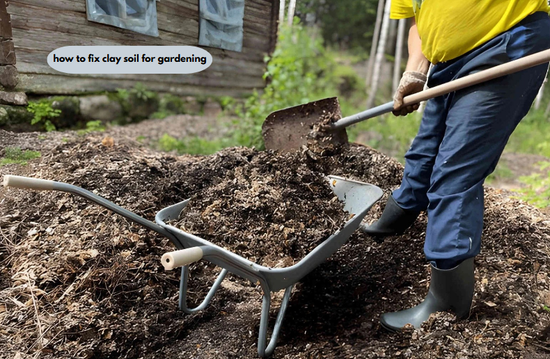
Organic matter, careful timing, and living roots do the real work. Combine several of these methods, starting with compost.
1. Work in compost the first year.
Spread 2 to 3 inches of finished compost and blend it into the top 6 to 8 inches with a garden fork or broadfork.
Plant-based compost is the safest choice. Some manure blends carry enough salt to burn seedlings in slow-draining clay, so ask the supplier for a lab analysis before you order a truckload.
2. Amend in fall and never dig wet clay.
Fall is the best season to amend clay, because freeze-thaw cycles and earthworms finish mixing the compost before spring planting. No freezing winters where you live? Amend at the start of the cool season instead, and rely more on mulch and cover crops, since there’s no frost to break up clods.
Wait until a squeezed handful crumbles instead of forming a shiny ball. Working saturated clay smears the particles flat, and those smeared layers dry into something close to brick. Lay boards or stepping stones between rows so your weight never lands on planting soil.
3. Keep the surface mulched.
A 2- to 3-inch blanket of shredded leaves, straw, or wood chips shields clay from pounding rain and summer cracking.
A cheap garden runs on exactly this kind of free input. Bagged fall leaves from neighbors and chipped branches from local tree crews cost nothing, and earthworms drag that mulch downward, carving channels for air and water.
4. Grow cover crops in the off-season.
Sow cereal rye, crimson clover, or daikon radish in early fall.
Radish taproots drill a foot or more into heavy ground, then rot over winter, leaving tunnels that spring roots and rainwater follow. Scattering radish seed in September takes the least labor of any method here for the biggest structural change. It’s one of our favorite simple gardening ideas for heavy ground.
5. Build raised beds where water stands.
Raised beds 10 to 12 inches tall give roots loose soil immediately while the clay below improves. Loosen the clay floor with a fork before filling; garden beds set straight onto compacted clay turn into bathtubs after heavy rain.
6. Try no-dig sheet mulching.
Cover the area with plain cardboard, soak it, and pile 4 to 6 inches of compost and leaves on top.
By the following spring, worms and fungi have pulled much of that material into the clay surface with no tilling. Designing gardens this way works best when you convert lawn to planting space, since the cardboard smothers turf grass in one season.
7. Let deep roots finish the job
Perennials with muscular roots, such as switchgrass, purple coneflower, and comfrey, fracture subsoil that no shovel reaches. Cut them at ground level at season’s end instead of pulling them, so decaying roots leave organic matter exactly where clay needs it.
That’s why they belong in any long-term garden designs on clay: they keep improving the soil every year with no extra work from you.
| Method | Time to visible change | Effort | Material cost | Best for |
| Compost worked in | One season | High in year one | Low to medium | New vegetable beds |
| Fall timing, no wet digging | Immediate | Low | None | Every garden |
| Mulch | One to two seasons | Low | Low | Perennial borders |
| Cover crops | One winter | Low | Low (seed only) | Large plots |
| Raised beds | Immediate | Medium | Medium to high | Fast harvests |
| Sheet mulching | 6 to 12 months | Low | Low | Converting lawn |
| Deep-rooted perennials | Two to three years | Low | Low | Low-maintenance yards |
How much compost does clay soil need?
Plan on 2 to 3 inches of compost a year for the first three years, then a 1-inch top-dressing each spring once you hit the target. Each inch spread over 1,000 square feet equals about 3.1 cubic yards.
Colorado State University Extension sets the goal for garden soil at 4 to 5 percent organic matter. Hold that target against the organic matter line on your soil report: a reading of 2 percent means at least two more seasons of heavy compost before you drop to maintenance rates.
Once a test confirms you have reached the target, switch to a 1-inch top-dressing each spring. Heavier yearly loads waste money and, with manure-based products, build up salts.
Does adding sand or gypsum fix clay soil?
Usually not. Sand often makes clay harder, and gypsum only helps soil that holds too much sodium.
Why sand backfires
It sounds logical: sand drains, so sand should loosen clay. But tiny clay particles fill the spaces between sand grains, and the mix dries almost like adobe brick.
You would need roughly equal parts sand and clay to improve drainage. For one bed, that means tons of sand. Compost does more with far less.
When gypsum helps
Iowa State University Extension and Outreach notes that gypsum does little for Iowa soils and is mostly used on sodic soils, found mainly in dry parts of the western U.S. If you garden east of the Rockies, put that money into compost or a soil test.
The exception is sodic clay in arid Western yards. It has a pH above 8.5 and turns into slick mud that clouds water for days. Here, gypsum plus deep watering to wash out the sodium is the right first step.
A soil test that shows sodium levels tells you which case you have.
How much does it cost to fix clay soil?
Most home gardens cost under $150 to fix when you buy bulk compost from a city or county facility and add one soil test. Bagged compost multiplies that bill many times over.
| Cost item | Price | Source |
| Home lawn and garden soil test mailer | $26 per sample | Michigan State University Extension, 2025 |
| Soil test mailed through a county office | $15 per sample plus $10 postage | University of Wisconsin–Madison Division of Extension, 2025 |
| Bulk compost, resident rate | $10 per cubic yard | City of Fort Smith, Arkansas |
| Screened compost, loaded by staff | $20 per cubic yard | Town of Bethlehem, New York |
| Bagged compost | $5 per 0.5-cubic-foot bag | Town of Bethlehem, New York |
Here is the math for a 1,000-square-foot vegetable plot. A 3-inch layer equals 250 cubic feet, or about 9.3 cubic yards; at the lowest bulk rate in the table, that comes to roughly $93. The same volume in half-cubic-foot bags means 500 bags and about $2,500, so bulk wins by a factor of 27. Add the $26 mailer, and the full fix still lands near $120.
U.S. households spent a record $740 each on lawn and garden activities in 2025, according to the National Gardening Survey 2026 Edition from Garden Research. The $120 clay fix above uses about one-sixth of that yearly budget, and it pays back every season afterward.
Anyone weighing how much does gardening cost should count soil prep as the cheapest line item with the longest return.
What plants grow well in clay soil?
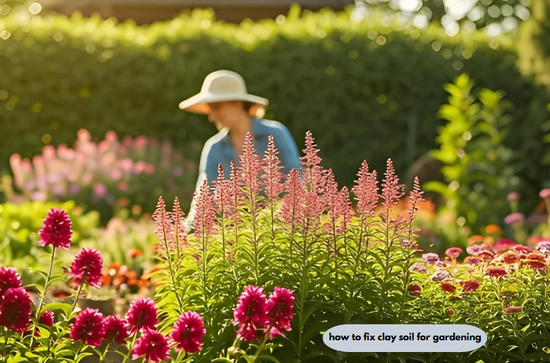
Many perennials, shrubs, and heavy-feeding vegetables thrive in clay because it stores water and nutrients. Plant them first while your amendments take effect.
Clay-tolerant,Easy to grow plants include black-eyed Susan, purple coneflower, daylily, New England aster, bee balm, ninebark, and red twig dogwood. Cabbage, broccoli, kale, beans, and squash also handle heavy ground better than carrots or potatoes, whose roots fork or rot in dense soil.
How should you plan a garden on clay soil?
Put vegetables on the highest, best-drained ground and send runoff toward plants that tolerate wet feet.
When you design a garden layout on clay, walk the yard after a hard rain and mark every puddle. The lowest spot becomes a rain garden of native sedges and swamp milkweed, and the driest strip becomes your vegetable plot.
Frequently Asked Questions
How long does it take to fix clay soil?
Most clay beds become workable within one growing season and reach good structure after two to three years of annual compost. The pace depends on how much organic matter you add and whether mulch protects the surface between crops.
Can you fix clay soil without tilling?
Yes, sheet mulching and yearly compost top-dressing improve clay with no tilling at all. Worms and roots pull the material downward, and the soil keeps its natural pore network intact.
Is clay soil good for vegetables?
Clay grows excellent vegetables once it drains well, because it holds more nutrients and moisture than sandy soil. Begin with leafy greens, brassicas, and squash, and save root crops for raised beds until the ground loosens.
Do coffee grounds help clay soil?
Coffee grounds help clay only as one ingredient in compost or mulch, not as a thick layer alone. Scatter them thinly or mix them with leaves, because a dense mat of grounds crusts over and sheds water.
What is the cheapest way to improve clay soil?
The cheapest method pairs free fall leaves as mulch with cover crops grown from seed. Many towns also give away or discount leaf compost each spring, so check municipal programs before buying any bagged product.
Conclusion
Knowing how to fix clay soil for gardening comes down to three habits: add organic matter every year, keep feet and tools off wet ground, and keep living roots in the soil. Skip sand and gypsum unless a soil test proves sodium is the culprit. Treated with patience, clay becomes some of the richest growing ground you will ever plant.