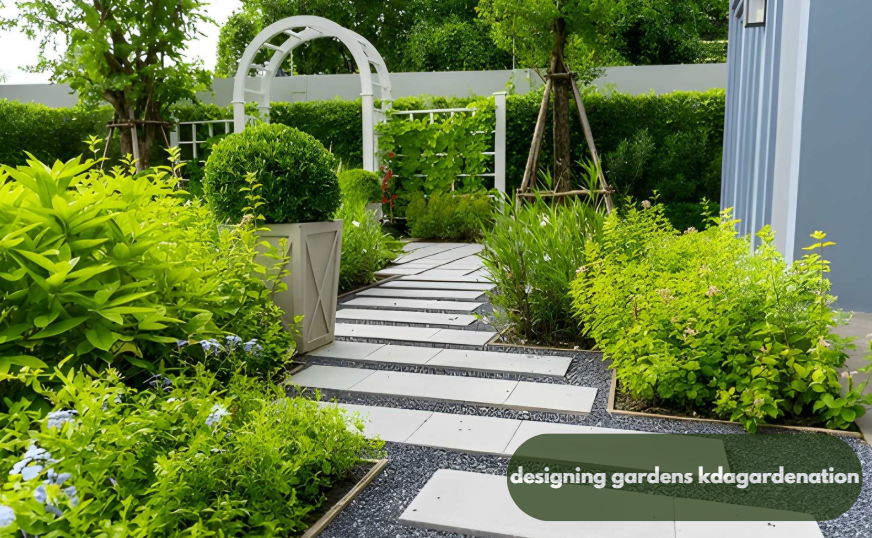
Designing gardens KDAGardenation style means mapping sun, soil, and access first, then fitting beds, paths, and seating to those limits before buying a plant. Start with a scaled sketch, keep beds 4 feet wide or less, and put sun-loving plants where they get at least 6 hours of direct light.
Key Takeaways
- Vegetables need a minimum of 6 hours of direct sun a day, according to Mississippi State University Extension and Penn State Extension.
- A bed reached from both sides should be no wider than 4 feet, which keeps the longest reach at 2 feet.
- Two 4-by-8-foot beds with 2-foot paths fill a 12-by-14-foot footprint, and only 38 percent of that footprint is planting space.
- In the Northern Hemisphere, a south-facing garden receives the most direct sun and a north-facing garden receives the least.
- U.S. gardening households spent a record average of $740 in 2025, according to the National Gardening Survey 2026 Edition.
What is designing gardens KDAGardenation?
Designing gardens KDAGardenation is a site-first planning method in which you measure light, soil, and space before you choose any plant, bed, or piece of furniture. The order matters because plants and materials are the expensive part, and the site decides which of them will last.
Can I design my own garden?
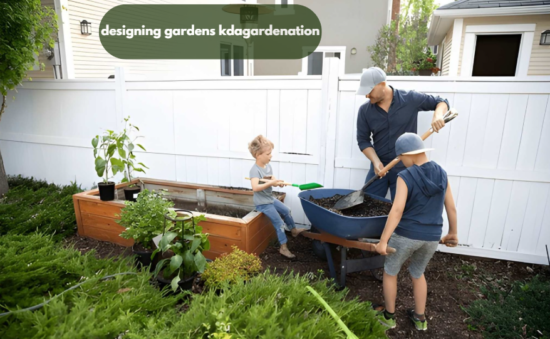
Yes. A home gardener can design a garden layout with a tape measure, graph paper, a compass app, and a single day spent watching where the sun falls.
People who ask “can I design my own garden” usually lack confidence, not skill. In the National Gardening Association’s 2026 research, 61 percent of respondents said they would garden more if they knew more, which makes a written plan the cheapest upgrade available.
The KDAGardenation Guide breaks the job into six steps, worked in order:
- Measure and draw. Sketch the plot on graph paper with one square equal to one foot, so every bed and path can be checked against real dimensions.
- Mark what cannot move. Add doors, taps, trees, drains, and fences. Mississippi State University Extension advises contacting your utility-locating service before any digging.
- Track the light. Note which areas are sunny or shaded in the morning, at midday, and in the evening, then total the hours for each zone.
- Test the soil. Penn State Extension distributes mail-in soil analysis kits through county offices, and most extension services offer a similar test.
- Place beds, paths, and seating. Draw them on the sketch, then stake the outlines with twine and walk the routes before building anything.
- Choose plants last. Match each plant to the light hours you recorded in step 3.
Which direction should your garden face?
In the Northern Hemisphere, a south-facing garden gets sun for most of the day and suits the widest range of plants. East, west, and north aspects all work, but each one changes what grows well and where seating belongs.
If you are unsure which direction should your garden face for a specific use, find the aspect first. BBC Gardeners’ World Magazine recommends standing with your back to the rear wall of the house and reading a compass: the direction ahead of you is the garden’s aspect.
| Garden faces | Sun pattern | Best use |
| South | Direct sun for most of the day | Vegetables, sun-loving flowers, main patio |
| West | Shaded mornings, sun through afternoon and evening | Evening seating, heat-tolerant plants |
| East | Morning sun, afternoon shade | Leafy greens, plants that scorch in afternoon heat |
| North | Shade for most of the day | Shade-tolerant foliage, climbers such as ivy |
The table describes the whole plot, but each boundary has its own aspect. In a south-facing garden the far fence faces north and stays mostly shaded, so shade plants belong there even though the plot counts as sunny.
The same source defines partial shade as roughly 3 to 6 hours of summer sun. That is below the 6-hour minimum vegetables need, so a partly shaded zone suits ornamentals better than tomatoes.
How do you size garden beds and paths?
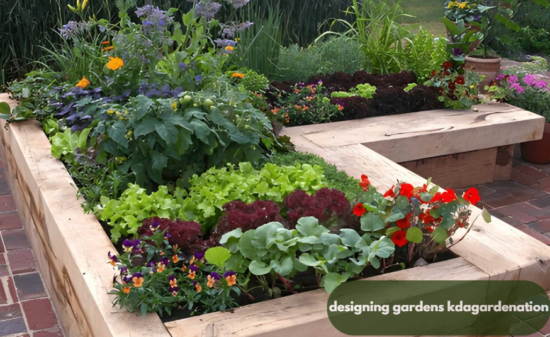
Size every bed by arm reach: 4 feet wide at most when you can reach it from both sides, and narrower when you cannot. Designing garden beds around reach means you never step on the soil and compact it.
University extension guidance agrees on the key numbers:
- Two-sided access: maximum 4 feet wide (Mississippi State University Extension, Penn State Extension).
- One-sided access: maximum 3 feet wide (University of California Agriculture and Natural Resources).
- Against a fence or shed: 2 to 2.5 feet wide (University of California Agriculture and Natural Resources).
- Depth for raised beds: at least 12 to 18 inches, according to Southern Exposure Seed Exchange’s May 2026 raised bed guide.
- Paths: about 2 feet wide or more, from the same guide.
Worked example: two beds on a 12-by-14-foot plot
Two standard 4-by-8-foot raised beds need a 12-by-14-foot footprint once paths are included. Here is the arithmetic, assuming a 2-foot path around and between the beds.
- Width: 2 + 4 + 2 + 4 + 2 = 14 feet.
- Length: 2 + 8 + 2 = 12 feet.
- Total footprint: 14 × 12 = 168 square feet.
- Planting area: 2 × 32 = 64 square feet, or 38 percent of the footprint.
- Soil at 12 inches deep: 64 cubic feet, which equals about 2.4 cubic yards (64 ÷ 27).
The soil figure uses the length × width × depth formula from Mississippi State University Extension. Ordering by the cubic yard instead of by the bag is practical once you pass 1 cubic yard.
The common mistake: drawing beds without paths
Most first sketches show only the beds, so the plan looks like it fits and then fails on the ground. In the example above, paths take 104 of 168 square feet, which is 62 percent of the space.
The fix is to draw paths first. Put the main route from the door to the tap and the compost area on paper, then fill the leftover blocks with beds.
What are modern small garden ideas on a budget?
Modern Small Garden Ideas On Budget come down to three moves: fewer materials, repeated plants, and one focal point. A Kdagardenation plan costs less because every purchase has a measured place.
For a spending benchmark, the National Gardening Survey 2026 Edition reports that U.S. gardening households spent a record average of $740 in 2025, with the total market reaching $79.0 billion. Separately, Axiom’s 2026 Gardening Outlook Study found that 63.6 percent of respondents intend to plant more and expand their gardens in 2026.
Those two figures measure different things. The first is reported past spending across U.S. households, and the second is stated intention among one survey’s respondents, so neither one predicts what your own project will cost.
Simple garden designs repeat three or four plant types across the plot instead of one of everything. Repetition lets you buy in multiples, divide plants later, and keep a small space visually calm.
Front yard flower beds
The strongest front yard flower garden ideas start with aspect, because a front yard faces the opposite direction from the back. A house with a south-facing rear garden has a north-facing front, so shade-tolerant flowers belong by the front door.
Keep a bed along the house wall to 2 to 2.5 feet deep. That matches the one-sided reach limit, so you can weed the back row from the lawn.
How to decorate a garden bench
To decorate a garden bench, pick its position before its accessories. The Royal Horticultural Society notes that a seat in morning sun is usually shaded by evening, so a second seat in a west-facing spot covers both ends of the day.
Then add a pot on each side for symmetry, weatherproof cushions in one accent color, and a climber or tall grass behind the bench to frame it.
When does the standard advice not apply?
The south-is-best rule reverses in the Southern Hemisphere, where north-facing gardens receive the longest sun. In hot-summer climates a west-facing bed takes the harshest afternoon heat, and BBC Gardeners’ World Magazine notes that plants there must tolerate it, so tender crops do better with an east aspect. Renters and balcony gardeners should swap fixed beds for containers that follow the light. Vegetable beds near black walnut trees are another exception: Penn State Extension warns that the tree releases a toxin that stunts vegetables, tomatoes in particular.
Frequently Asked Questions
How do I start planning a garden from scratch?
Start by measuring the plot and recording how many hours of direct sun each area receives. Those two facts decide where beds, paths, and seating go, and they cost nothing to collect. Plant shopping comes only after the sketch is finished.
What is the best direction for a garden to face?
South is the best direction in the Northern Hemisphere because it gives the longest period of direct sun. West-facing plots come second for evening use, while east-facing plots suit morning light and cooler afternoons. In the Southern Hemisphere, swap north for south.
How wide should a garden bed be?
A garden bed should be 4 feet wide at most when you can reach it from both sides. Reduce that to 3 feet for one-sided access and to about 2 feet against a wall or fence, following University of California guidance.
How much soil does a 4-by-8-foot raised bed need?
A 4-by-8-foot raised bed filled 12 inches deep needs 32 cubic feet of soil, which is about 1.2 cubic yards. To convert to cubic yards, multiply length by width by depth in feet, then divide the result by 27.
Do I need a professional to follow the KDAGardenation Guide?
No, the Kdagardenation method uses a tape measure, graph paper, a compass app, and a soil test, all of which a beginner can handle. A professional designer becomes worthwhile for retaining walls, drainage work, or steep slopes, where structural mistakes are costly to undo.
Conclusion
Designing gardens KDAGardenation style puts measurement ahead of shopping: light hours, bed widths, and path routes go on paper before anything goes in the ground. A plan that gives 4 feet to each bed and 2 feet to each path will fit the first time you build it. Spend one day observing your site, and every later decision gets cheaper.