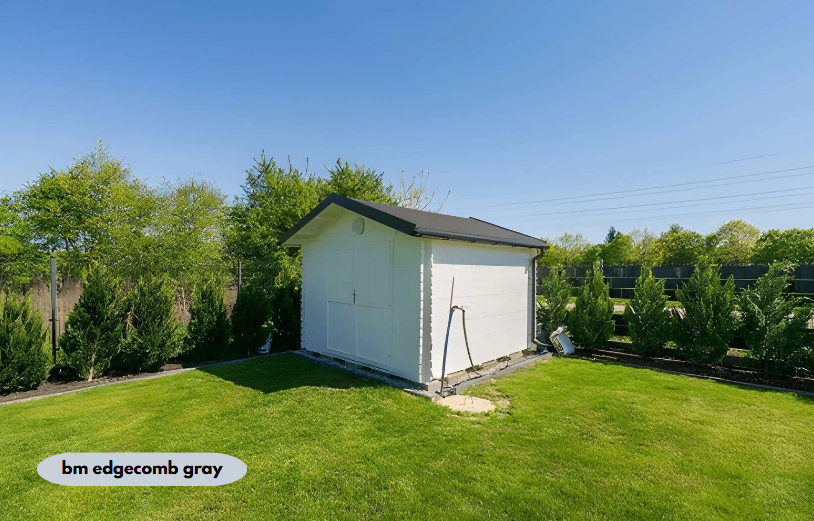
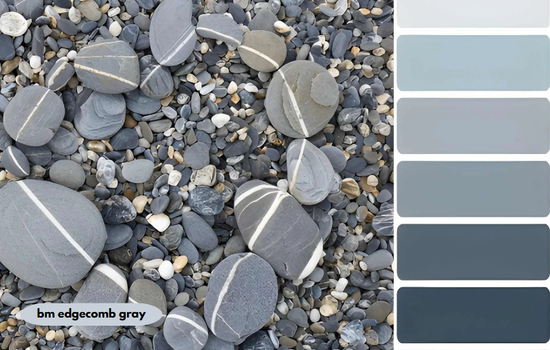
BM Edgecomb Gray is a warm, light greige that makes a garden shed look settled and finished without competing with plants, especially beside crisp white trim and a deep navy or green door. Test a large sample on two sides of the shed, then buy paint by measured square footage.
Key Takeaways
- Edgecomb Gray (HC-173) is a light greige that leans sandy beige in afternoon sun and reads grayer in shade.
- An 8-by-10-foot shed with 7-foot walls has about 238 square feet of paintable siding once you subtract one door and one window.
- Two body coats on that shed take roughly one gallon plus one quart of premium exterior paint, or two full gallons on rough T1-11 siding.
- White trim and a navy, green, or espresso door give the color the contrast it lacks on its own.
- Testing 2-by-2-foot sample boards on the sunniest and shadiest walls prevents the most common color mistake.
What Is BM Edgecomb Gray?
BM Edgecomb Gray (HC-173) is a light greige paint color that blends soft gray with a sandy beige base, so it reads neutral rather than cold on exterior siding.
How Does Edgecomb Gray Look on a Shed Outdoors?
Outside, Edgecomb Gray looks lighter and warmer than the paint chip. Direct sun pushes it toward soft khaki, while shade pulls it back to gray.
The HC-173 color page lists a light reflectance value of 63.09. On a 0-to-100 scale, that puts the color in the light-to-medium band, so a shed baking in afternoon sun reads noticeably paler than the sample in your hand.
Decide where the shed sits before you judge the color.
Sunny Spot or Shady Corner?
In full sun, Edgecomb Gray needs strong trim contrast to keep its shape. In shade, it holds up on its own.
South- and west-facing walls draw out the beige. North-facing walls go cooler, and that blue-gray cast looks clean next to hostas, ferns, and boxwood. Anyone asking “Can I design my own garden around a shed?” should map this sun pattern before choosing either the paint or the plants.
The Most Common Mistake and the Fix
Most homeowners choose Edgecomb Gray from a 2-inch chip under kitchen lights. Outdoors, the same color washes out on a bright wall, and the paint gets the blame.
The fix takes one afternoon. Brush a sample quart onto two 2-by-2-foot boards, lean one against the sunniest wall and one against the shadiest, and check both at 9 a.m., noon, and 5 p.m. If the sunny board looks too pale, move to a deeper greige for the body and keep Edgecomb Gray for the trim.
What Colors Go With Edgecomb Gray on a Garden Shed?
Bright white trim and a dark door give Edgecomb Gray the definition it needs. The wider the gap in light reflectance between body and accent, the crisper the shed looks from across the yard.
Use this rule of thumb: a gap under 10 points reads as tone-on-tone, and a gap over 25 points reads as sharp contrast. The gap column measures each accent against Edgecomb Gray’s 63.09.
| Shed element | Color | LRV | Gap from Edgecomb Gray | Visual effect | Source |
| Trim and corner boards | Chantilly Lace OC-65 | 90.04 | 26.95 | Crisp cottage outline | Benjamin Moore, Chantilly Lace OC-65 color page |
| Door | Hale Navy HC-154 | 8.36 | 54.73 | Strong focal point | Benjamin Moore, Hale Navy HC-154 color page |
| Shutters or window boxes | Revere Pewter HC-172 | 55.05 | 8.04 | Quiet tone-on-tone depth | Benjamin Moore, Revere Pewter HC-172 color page |
Three Shed Palettes That Work
Each palette below keeps Edgecomb Gray on the body and changes only the accents. Whether you borrow a scheme from kdarchitects or build your own, keep the body color fixed and test accents against it.
- Classic cottage: Chantilly Lace trim, a Hale Navy door, and black strap hinges, framed by lavender and white panicle hydrangeas.
- Soft farmhouse: Edgecomb Gray on body and trim, a natural cedar door, and a galvanized metal roof, with feather reed grass along the base.
- Moody modern: an espresso-brown door and window frames, matte black hardware, and a gravel apron instead of lawn.
How Much Paint Does a Garden Shed Need?
An 8-by-10-foot shed with 7-foot walls needs about one gallon and one quart for two body coats, or two gallons on rough siding. Here is the math for that shed:
- Measure the perimeter: 8 + 10 + 8 + 10 = 36 feet.
- Multiply by wall height: 36 × 7 = 252 square feet.
- Add both gable triangles. A 2-foot rise across an 8-foot end gives 8 square feet each, so the total climbs to 268.
- Subtract openings. A 4-by-6-foot door (24) and a 2-by-3-foot window (6) leave 238 square feet.
- Double it for two coats: 476 square feet.
- Divide by the coverage rate on the can.
The Aura Exterior Soft Gloss technical data sheet puts coverage at 350 to 450 square feet per gallon. At the low end, 476 square feet takes 1.36 gallons; at the high end, just 1.06.
Smooth, primed siding lands near the high end. Grooved T1-11 and rough-sawn cedar drink paint and fall below the low end, so a second full gallon covers the shortfall and leaves enough for touch-ups. Measure first and buy second, the same habit the KDAGardenation Guide applies to planting beds.
What Does It Cost to Paint a Shed in Edgecomb Gray?
Paint for the body of a standard 8-by-10 shed runs about $143 to $198 in a premium exterior line. Trim and door colors add roughly $88 more.
Coatings Pro Magazine reported suggested retail prices of $43.99 per quart and $98.99 per gallon when the enhanced Aura Exterior launched in 2022. One gallon plus one quart comes to $142.98, and two gallons come to $197.98.
Add a quart each of trim white and door color, and the three-color job lands between $231 and $286. Dealer prices shift by region and year, so ask your local store for a current quote and any five-gallon or seasonal discount before you buy. Spend the savings on plants, but first hold your landscape ideas from morph boards, magazines, or garden tours up against a photo of the freshly painted shed.
How Do You Design a Garden Layout Around a Gray Shed?
Treat the shed as the anchor and let the path, beds, and plants radiate from its door. A neutral body color hands the job of carrying color to the plants.
Plan the Layout First
When you design a garden layout around a shed, settle the bones before you buy a single plant:
- Aim the main path straight at the door and keep it at least 3 feet wide for a wheelbarrow.
- Sketch the yard on graph paper at one square per foot, marking sun and shade by hour.
- Place tall shrubs at the back corners and step heights down toward the path.
- Work in order: hardscape, then structure plants, then seasonal color.
Choose Plants That Flatter Gray
Silver, purple, and white foliage look best against gray siding.
- Lamb’s ear and catmint for silver edging
- Salvia for purple spikes
- Annabelle hydrangea for white mass
- Chartreuse hostas for shady corners
- Dark brown or black mulch, since yellow-beige mulch muddies the base
Add a 2026 accent.
An espresso-brown accent keeps the shed current without a full repaint. Benjamin Moore’s Color of the Year announcement, dated October 16, 2025, named Silhouette AF-655, an espresso brown with charcoal notes, as its 2026 pick. Paint the door, a bench, or the window boxes in that shade, and you skip repainting all 238 square feet of siding.
What If Your Shed Is Resin or Plastic?
Resin and plastic sheds are the exception to all of this advice. Standard exterior latex tends to peel off polyethylene unless you scuff the surface and use a bonding primer rated for plastic, and some resin-shed makers void the warranty once you paint. For a resin shed, put Edgecomb Gray on the planters, a fence panel behind it, or a potting bench instead; in designing gardens around an unpaintable shed, those surrounding surfaces carry the color story.
FAQ
Is Edgecomb Gray too light for a shed exterior?
No, Edgecomb Gray works on shed exteriors as long as the trim and door supply contrast. On a shed in full, all-day sun, consider a deeper greige for the body and use Edgecomb Gray as the trim color.
Does Edgecomb Gray look beige outside?
Yes, it leans beige in strong afternoon sun and grayer in shade or north light. Large sample boards on two walls show you which version your yard produces.
What door color goes with an Edgecomb Gray shed?
Navy, deep green, or espresso brown gives an Edgecomb Gray shed the strongest focal point. Pick the door color after the body is painted, since the finished wall changes how every accent reads.
What sheen should I use on a garden shed?
Satin or low-luster sheen suits most shed siding because it resists dirt and hides board flaws. Use a higher-gloss finish on the door and trim so they wipe clean after muddy-glove handling.
Can I paint a shed in Edgecomb Gray myself?
Yes, one person can prep and paint an 8-by-10 shed over a dry weekend. Wash the siding, let it dry for a full day, spot-prime bare wood, then roll two coats and back-brush the grooves, following the recoat time and minimum temperature printed on the can.
Conclusion
A garden shed in BM Edgecomb Gray works best as a quiet backdrop, sharpened by bright white trim and a dark, confident door. Test the color where the shed actually stands, measure the walls before you buy, and let the planting supply the color.
