
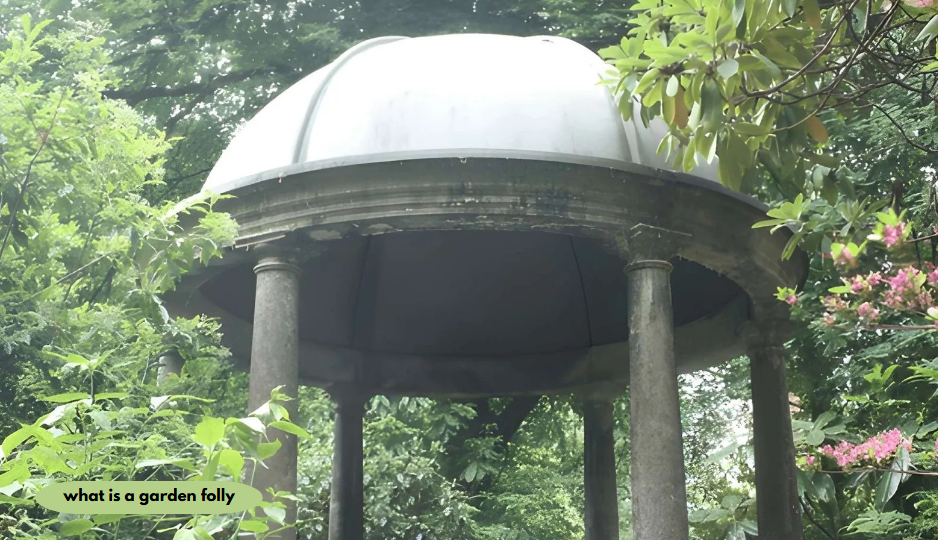
What is a garden folly? It’s an ornamental building placed in a landscape to be admired, such as a mock ruin, miniature temple, or sham tower, with little or no practical use. Adding a folly gives a garden something to look at and somewhere to walk to.
Key Takeaways
- A garden folly is basically a structure built to be looked at, not used.
- The seven classic folly types are mock ruins, temples, towers, grottoes, hermitages, eyecatchers, and exotic pavilions.
- English landscape gardens of the 1700s made follies fashionable, and the idea later spread to America.
- Well-known examples include Stowe and Stourhead in England, the Gothic Temple at Painshill, the Dunmore Pineapple, the Désert de Retz, and the Watts Towers.
- A folly works best at the end of a sightline, viewed from a fixed point such as a window.
What Is a Garden Folly?
A garden folly is a building or structure designed chiefly for its looks and the mood it creates, with any practical use treated as secondary.
Garden Design writers use the term for anything from a mossy fake ruin to a full-size castle, as long as appearance drives the project. The name comes from the French “folie,” meaning madness or extravagance, a word the French also used for a lavish pleasure house.
How Can You Tell If a Structure Is a Folly?
A structure counts as a folly when it passes three tests: its look outweighs its use, it evokes another time or place, and it sits as a destination within a view.
A plain gazebo fails the second test. Rebuild it as a tiny Greek temple at the far end of a lawn, and it passes all three.
What Are the Main Types of Garden Follies?
Most garden follies fall into seven families, each with its own mood.
- Mock ruins: Broken arches, roofless walls, or a lone column built new to look centuries old.
- Temples: Small classical pavilions with columns and a dome or pediment, often set on a rise above water. Italian-style versions often stand between paired cypress trees.
- Towers and sham castles: Tall, narrow structures with battlements, sited on high ground so they show from far away.
- Grottoes: Artificial caves lined with shells, rough rock, or crystals.
- Hermitages: Rough huts made of bark, thatch, or root wood, hinting at a quiet, tucked-away life.
- Eyecatchers: Flat fronts, gateways, or arches put up to finish off a distant view, often just a shell.
- Exotic pavilions: Chinese pagodas, Turkish-style tents, and Egyptian pyramids meant to whisk you off somewhere far away.
Why Did People Build Garden Follies?
Wealthy landowners built follies to show taste, display wealth, and turn a walk into a sequence of staged scenes.
During the 1700s, English landowners designing gardens swapped clipped hedges for rolling lawns, lakes, and winding paths. Temples and ruins placed along a circuit walk revealed one new view after another, each composed like a landscape painting.
Follies also sent messages: a temple to liberty broadcast politics, while a fake ruin implied an ancient family line.
Many American follies are one-person projects rather than estate commissions. Edward Leedskalnin carved 1,100 tons of coral rock into Coral Castle over 28 years, according to the Greater Miami Convention & Visitors Bureau.
What Are Real Examples of Garden Follies?
Famous examples include Stowe and Stourhead in England, the Gothic Temple at Painshill, the Dunmore Pineapple in Scotland, the Désert de Retz in France, and the Watts Towers in Los Angeles.
Stowe and Stourhead, England
Stowe in Buckinghamshire holds more than 40 temples and monuments, many carrying political messages from its owner, Lord Cobham. Its Temple of British Worthies is the classic “temple with a message.” At Stourhead in Wiltshire, a Pantheon, a Temple of Apollo, and a grotto are set around a lake, so each one comes into view in turn along the circuit walk.
The Gothic Temple at Painshill, England
This pointed-arch pavilion above a lake exists purely to frame views. Its creator, Charles Hamilton, also built a ruined abbey, a Turkish tent, and a crystal grotto in the same park.
The Dunmore Pineapple and the Désert de Retz
In Scotland, a giant stone pineapple crowns a garden pavilion, advertising wealth when the fruit was a rare luxury. Near Paris, the Désert de Retz holds a pyramid and a house built inside an enormous broken column, proof that intent, not uselessness, defines a folly.
The Watts Towers, Los Angeles
Simon Rodia, a construction worker, built these folk-art towers by hand from steel, mortar, broken tile, and glass. His tallest tower stands about 99 feet, per the National Park Service’s National Register nomination for the site.Rodia worked on the towers alone for more than 30 years, from 1921 to 1954.
How Do You Add a Garden Folly to Your Yard?
Pick a sightline first, then choose a folly type that suits your land. Placement matters more than size: a small folly in the right spot beats a large one in the wrong spot.
- Find the view. Note where your eye lands from the back door or a favorite bench. The folly belongs there.
- Sketch before you shop. Drawing your yard to scale on graph paper is the simplest way to design a garden layout that leads the eye to the folly. Mark it at the end of a path.
- Match the type to the ground. A ruin suits a slope or shady corner, a temple wants open lawn or water, and a tower needs high ground.
- Screen it partly. Use shrubs so the structure appears in glimpses first.
- Age it on purpose. Leave mortar rough and train ivy or climbing roses across the walls.
How Much Does a Garden Folly Cost? (US Prices).
A simple folly built on a pergola or gazebo frame usually costs a few thousand dollars, while custom stonework runs much higher.
Building a pergola averages $4,240 nationally, with most projects landing between $2,103 and $6,382, based on HomeAdvisor’s 2025 cost guide.That average is for a whole project. The table below prices by square or linear foot instead: at $37 per square foot, a 10-by-12-foot temple frame comes to about $4,440 before faux columns or veneer.
| Folly-style structure | How to make it read as a folly | Typical cost | Source |
| Pergola frame turned temple | Add round columns, a cornice, and urns | $20 to $60 per sq ft | LawnStarter, 2025 |
| Pergola frame, average rate | Same build at a midrange finish | $37 per sq ft | Lawn Love, 2026 |
| Gazebo turned pavilion | Set it on a mound and crown it with a finial | $7,600 national average; $5,358 to $9,058 typical | LawnStarter, 2025 |
| Trellis screen as a “ruin” | Arch the lattice and let climbers break up the outline | $200 per linear foot average; $60 to $350 typical | HomeAdvisor |
Saving landscape ideas from morph boards or magazines? Measure the footprint each one would need in your yard before pricing it. Scale, not style, sets the bill.
What Mistakes Should You Avoid With a Garden Folly?

The most common mistake is placing the folly too close to the house, where it reads as a cluttered outbuilding instead of a distant scene.
It happens because people build near the patio and utilities. A useful rule of thumb is to keep the viewing distance at least three times the folly’s height, so a 10-foot temple sits 30 feet or more from your main window.
The usual aging advice fails in hot, dry regions such as Arizona and inland Southern California, where moss and ivy struggle. There, let sun-bleached stucco or rough stone carry the sense of age. Mexican flowers suit both the look and the climate: Mexican bush sage, zinnias, and Mexican hat soften a folly’s base and handle heat that would scorch ivy. In HOA communities and historic districts, a fake ruin can fail design review even when it meets code, so get written approval first.
Frequently Asked Questions
What is the difference between a folly and a gazebo?
A gazebo is built for shade and seating, while a folly is built mainly to be looked at. A gazebo becomes a folly once its styling and placement turn it into a scene, such as a pavilion set on a mound at the end of a lawn.
Are garden follies expensive to build?
They don’t have to be, since a short ruin wall made from salvaged brick costs far less than a full pavilion. Height and masonry raise costs fastest.
Do I need a permit to build a garden folly?
You usually need one for anything with a foundation, a roof, or real height, though rules differ by city and county. Call your local building department with your dimensions before you dig.
Why are they called follies?
Outsiders saw them as foolish spending on buildings with no purpose, and the label stuck. Today it is a neutral design term.
Can a folly have a practical use?
Yes, as long as the look comes first and the function comes second. A tool shed dressed as a Gothic chapel still counts.
Conclusion
So, what is a garden folly? It is architecture built for wonder rather than work, and its power comes from placement, mood, and story far more than size. Choose a sightline, pick a type that fits your land, and let the structure age into the scene.