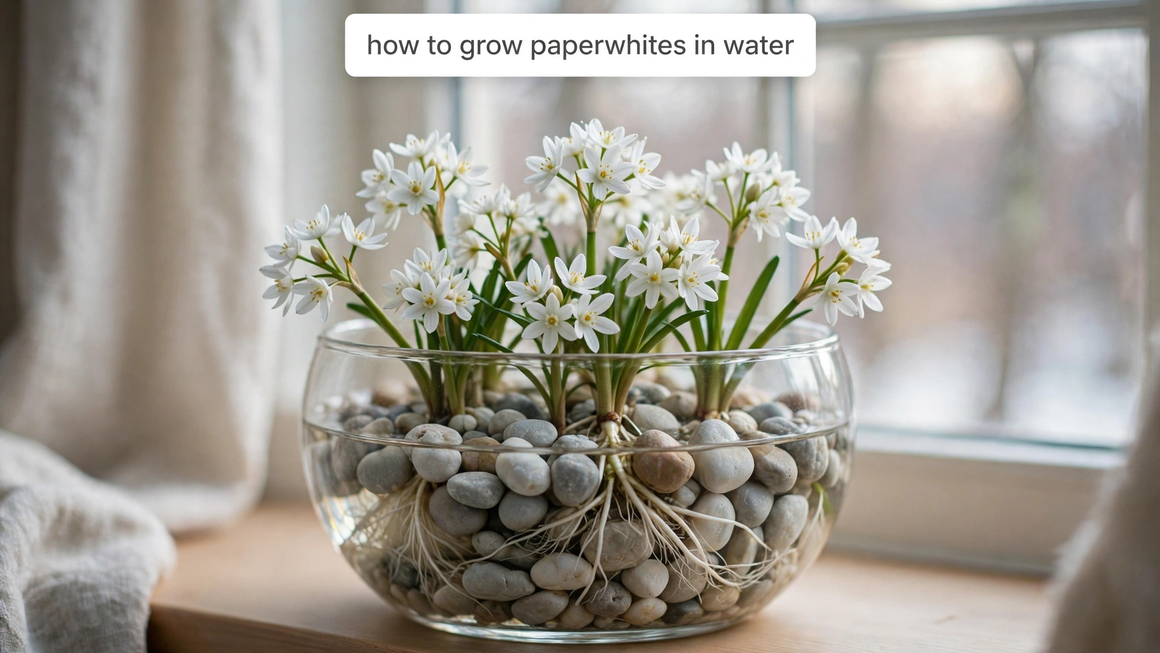
Learning how to grow paperwhites in water takes one bowl, a layer of pebbles, and bulbs set pointed-end up so the water line sits just below their bases. Keep the bowl cool and bright, refill it as roots drink, and fragrant white clusters will open in roughly a month.
Key Takeaways
- Paperwhites need no winter chilling, so bulbs can go into water the day you buy them.
- The waterline belongs just below the bulb base, because a submerged base rots before roots form.
- A 5 percent spirits solution, added once shoots appear, keeps stems short without shrinking the flowers.
- Planting a new bowl every two weeks gives overlapping blooms from late November to late February.
- Bulbs forced in water use up their stored food and rarely flower a second time.
What Are Paperwhites?
Paperwhites are tender Mediterranean narcissus bulbs that produce clusters of small, intensely scented white flowers without needing a cold period first.
Botanists classify them as Narcissus papyraceus, part of the tazetta group of daffodils. Hard frost kills the buds and flowers. That’s why they rarely appear in garden landscaping ideas outside the warmest parts of the country and why most Americans grow them indoors in winter.
What Do You Need to Grow Paperwhites in Water?
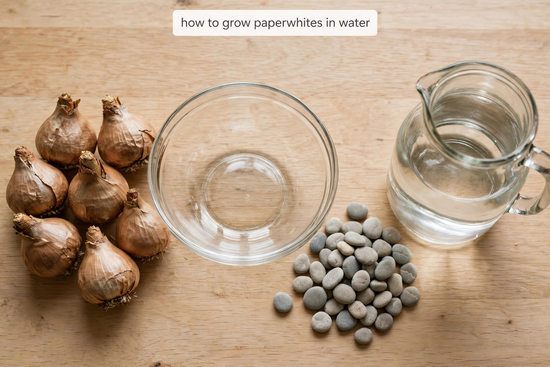
You need firm bulbs, a container with no drainage hole, pebbles, and plain water. You can skip soil and fertilizer, because each bulb already holds the food its flowers will use.
- Bulbs: Choose heavy, solid ones that feel like a good onion. Soft spots or blue mold mean rot has started. A short green tip is normal.
- Container: Use a bowl, vase, or glass cylinder that holds water.
- Anchor material: Pea gravel, river stones, marbles, or glass beads all work. Rinse them first.
- Water: Tap water is fine. If your home has a salt-based water softener, use water from a tap that bypasses it—softened water carries extra sodium, which most plants dislike.
Container height matters more than most beginners expect. Iowa State University Extension and Outreach reports that paperwhites typically grow 18 to 20 inches tall. In a 4-inch-deep bowl, that means foliage four to five times taller than the base holding it up. Pick a tall glass cylinder, or keep bamboo stakes and twine nearby.
Which paperwhite variety should you buy?
‘Ziva’ is the standard white in most kits, and it has the strongest scent. If fragrance bothers you, look for milder varieties such as ‘Inbal’ or ‘Wintersun’. ‘Grand Soleil d’Or’ has yellow petals around an orange cup, and ‘Erlicheer’ produces creamy-white double blooms in large, heavy clusters.
How should you store bulbs before planting?
Keep unplanted bulbs in a cool, dry, dark place inside a mesh or paper bag so air can circulate. Don’t store unplanted bulbs in a closed space with ripening apples or pears. The ethylene gas they give off can impair flower development, so bulbs may fail to bloom or flower distorted.
How to Grow Paperwhites in Water, Step by Step
Layer the pebbles, set the bulbs, add water to just below their bases, and let roots form somewhere cool before moving the bowl into strong light. Setup takes about ten minutes.
- Pour 2 to 3 inches of pebbles into the container and level the surface.
- Press each bulb into the pebbles, pointed end up, with their shoulders touching. Packed tightly, the stems prop each other up later.
- Add more pebbles until only the top third of each bulb shows.
- Pour in water until it reaches just below the bulb bottoms. Roots grow down to meet it, and the base stays dry.
- Set the bowl somewhere cool with indirect light, such as an unheated sunroom, until white roots wind through the stones.
- When green shoots stand a few inches tall, move the bowl to your sunniest window.
- Check the water every two days. A full set of roots drinks fast, and a dry bowl stalls the buds.
- Give the bowl a quarter turn every day or two so the stems grow straight instead of leaning toward the light.
Quick benchmarks for water-forced paperwhites
Use these figures to judge timing and placement at each stage.
| Benchmark | Figure | What it measures | Source |
| Shoot height before moving into bright light | 3 inches | When the bowl is ready to leave its rooting spot | Iowa State University Extension and Outreach |
| Growing temperature in a sunny window | 60–70°F | Daytime air temperature while stems and buds develop | Iowa State University Extension and Outreach |
| Nighttime temperature to limit leggy growth | About 50°F | Cool-down target that slows stretching | University of Missouri |
| Bulbs per shallow gravel bowl | 4–6 | How many bulbs to plant together | University of Missouri |
| Extra forcing time for ‘Grand Soleil d’Or’ | 1–2 weeks longer | How much later this yellow variety blooms than white types | Iowa State University Extension and Outreach |
| Alcohol strength that harms the plants | Above 10% | The point where the anti-flop solution turns toxic | Cornell University |
The two temperature rows measure different things. One is daytime warmth by the window. The other is a nighttime target, and cooling the room to it keeps stems compact.
When Should You Plant Paperwhites for Holiday Blooms?
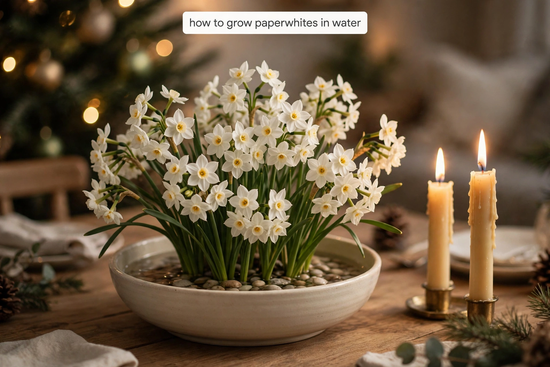
Work backward from the date you want flowers, and add a few days if your house runs cool. According to December 2025 guidance from University of Missouri horticulturist David Trinklein, bulbs flower about 4 to 6 weeks after planting, and new plantings every 2 weeks from November keep blooms coming through February.
For a Christmas Day centerpiece, plant between November 13 and November 27. A bowl started on Thanksgiving, November 26, lands at the fast end of that range, so give it your warmest bright window.
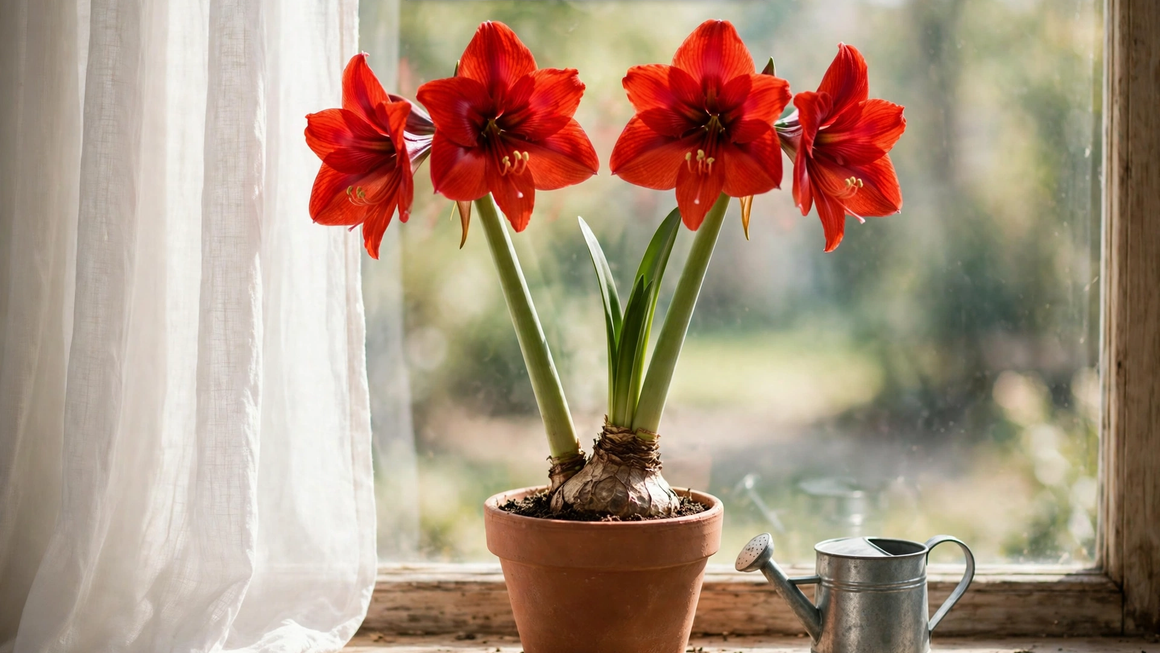
Six bowls planted on November 1, November 15, November 29, December 13, December 27, and January 10 overlap into continuous bloom from late November to late February. Paperwhites alone won’t give you year-round flowers. Pair them indoors with amaryllis—plant the amaryllis a couple of weeks earlier, since it is slower to bloom—and outdoors with other tender, mild-climate bulbs in zones 8–10, and color covers most of the calendar.
How Do You Keep Paperwhites From Flopping Over?
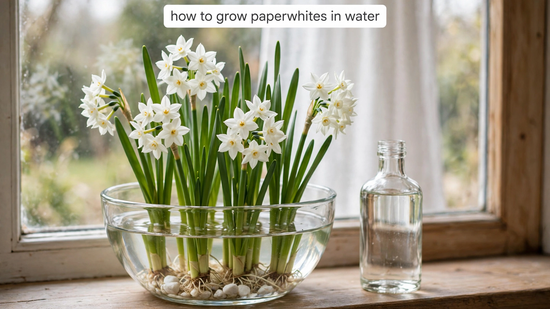
Once shoots reach 1 to 2 inches, replace the plain water with a diluted alcohol solution. The stems come up shorter and stiffer, and the flowers stay full size.
Research from Cornell University’s Flower Bulb Research Program found that a 4 to 6 percent alcohol solution kept paperwhites one-third to one-half shorter than bulbs grown in plain water, with no loss of flower size or fragrance. Apply that to the usual 18- to 20-inch height, and the treated stems top out near 9 to about 13 inches. Most bowls can hold that up without stakes.
Most vodka, gin, and whiskey sold in the U.S. is 80 proof, which means 40 percent alcohol. Here’s how to mix a 5 percent solution:
- 80-proof spirits: 1 part liquor to 7 parts water. One cup of vodka in 7 cups of water makes half a gallon.
- 70% isopropyl rubbing alcohol: 1 part alcohol to 13 parts water.
- 91% isopropyl rubbing alcohol: 1 part alcohol to 17 parts water.
Pour off the plain water first, then refill with the mix and use it for every top-up afterward. Don’t use beer or wine. Their sugars feed rot and don’t shorten the stems.
How Do You Make Paperwhite Blooms Last Longer?
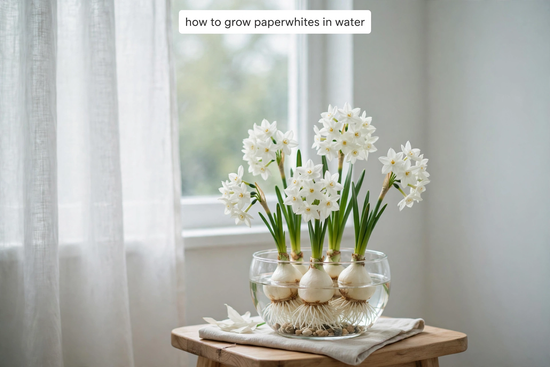
Once the flowers open, move the bowl out of direct sun and into the coolest bright room you have. Warm air speeds up the whole cycle, so blooms that sit in heat fade sooner.
A spare bedroom or a covered porch that stays above freezing makes a good overnight spot. Pinch off brown florets as they fade, and the cluster stays tidy while later buds open.
Paperwhites also work as cut flowers. Their stems release a sap that shortens the vase life of tulips and roses, so let freshly cut stems stand alone in water for several hours—ideally 12 to 24 hours—before you add them to a mixed arrangement, and do not recut the stems afterwards, or the sap starts flowing again.
You can group several bowls together for a bigger display. Stagger the container heights and repeat one color so the grouping looks planned rather than crowded.
Why Are My Paperwhites Rotting, Leaning, or Not Blooming?
Most problems come down to water depth, heat, or light. You can fix nearly all of them if you catch them early.
Mushy, sour-smelling bulbs
The water line is too high. People overfill because they worry the roots will run dry. Pour off water until the level sits below the bulbs, and throw out any bulb that dents when you squeeze it.
Pale, leaning foliage
The bowl started out too warm and too dark. A counter near the oven pushes leaves up before roots can anchor them. Move it somewhere brighter and cooler, then switch to the alcohol mix.
Buds that shrivel before opening
The roots dried out at a critical stage. Put a strip of tape on the glass at the correct water line so anyone in the house can spot a low bowl.
Leaves but no buds after two months
The flower bud probably died before you planted the bulb. Kansas State University Research and Extension’s January 2026 garden guidance says to expect blooms within eight weeks of planting. That’s a ceiling, not the typical timeline. If a bulb passes week eight with only leaves, compost it and start a fresh one.
One exception changes the indoor-only advice. In regions with very light frost, such as the Gulf Coast, south Texas, coastal California, and parts of Florida, fresh paperwhite bulbs planted in the ground come back every winter as perennials. Tazettas are the safest choice in Florida, and rebloom there can still be unreliable. If you design a garden layout in those areas, plant clumps of them near walkways and doors, where the scent reaches people without filling a closed room.
For entry and walkway plantings, landscape ideas from Morph show how to stagger heights and repeat one color so the grouping looks planned rather than crowded.
Frequently Asked Questions
Do paperwhites need to be chilled before forcing?
No, paperwhites bloom without any cold treatment, unlike tulips, crocuses, and most daffodils. Their native Mediterranean winters are mild, so the bulbs never developed a need for a cold period.
Can you grow paperwhites in a vase without pebbles?
Yes, a narrow-necked forcing vase holds one bulb above the water so only its roots reach down. Hourglass-shaped hyacinth glasses work the same way, and the clear sides let you watch the roots grow.
Why do my paperwhites smell bad?
Paperwhites release scent compounds that many people find musky or sharp, especially in a warm, closed room. Fresh air and cooler temperatures tone the smell down. Next season, choose a variety bred for a lighter fragrance.
Can you replant paperwhite bulbs after they bloom in water?
Usually not, because forcing in water drains the bulb’s stored energy. Indoor growers should compost spent bulbs. In frost-light regions, a spent bulb planted outdoors sometimes recovers, though it can take a couple of seasons to flower again.
Are paperwhites toxic to cats and dogs?
Yes, every part of a paperwhite is toxic to cats and dogs, and the bulb is the most dangerous part. Chewing on one commonly causes vomiting and drooling. Keep bowls out of reach, and call a veterinarian if a pet bites into a bulb.
Conclusion
Growing paperwhites in water comes down to three habits: keep the bulb bases dry, root the bowl somewhere cool, and give the shoots strong light. Once you know how to grow paperwhites in water, a 5 percent spirits mix and a cool spot for the open flowers give you compact stems and longer-lasting blooms.