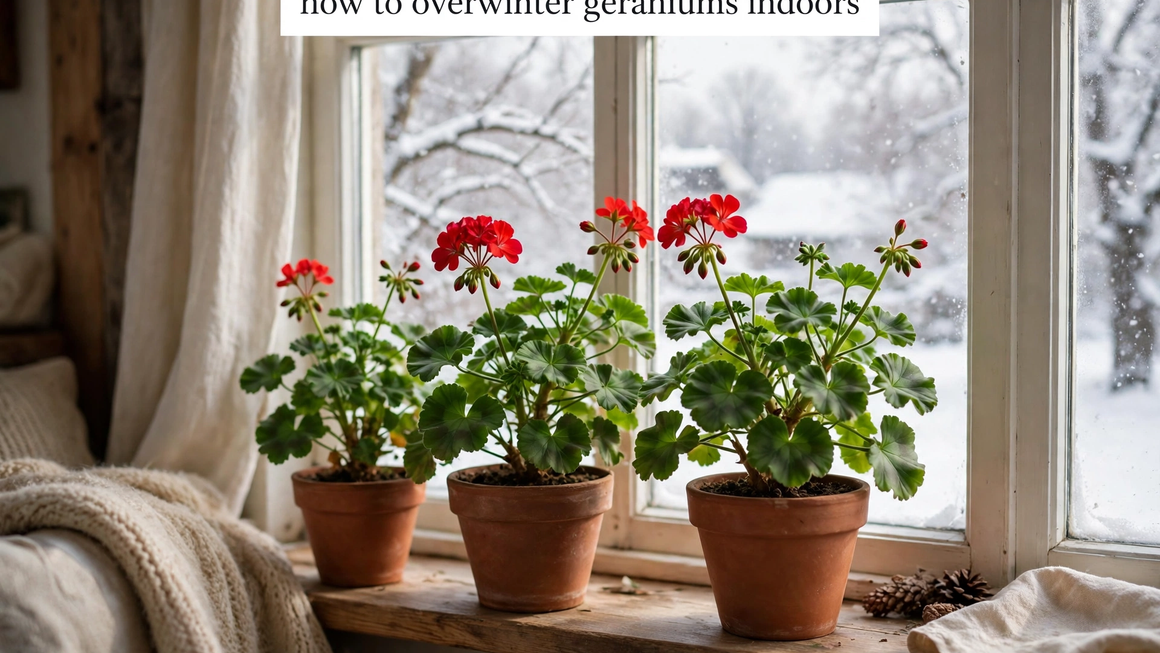
Learning how to overwinter geraniums indoors comes down to three choices: keep them growing as cool, sunny houseplants; store them dormant and bare-root; or root stem cuttings. Bring plants in before the first frost, cut them back, water sparingly, and replant after spring’s last frost.
Key Takeaways
- Garden geraniums (Pelargonium) die at the first hard freeze, so they must come indoors before frost.
- Three methods work: potted houseplants, dormant bare-root storage, and rooted stem cuttings.
- Cool nights and a south- or west-facing window keep indoor geraniums compact.
- Overwatering kills more overwintered geraniums than cold does.
- A hard prune in late winter resets stretched plants for spring.
What Does It Mean to Overwinter Geraniums?
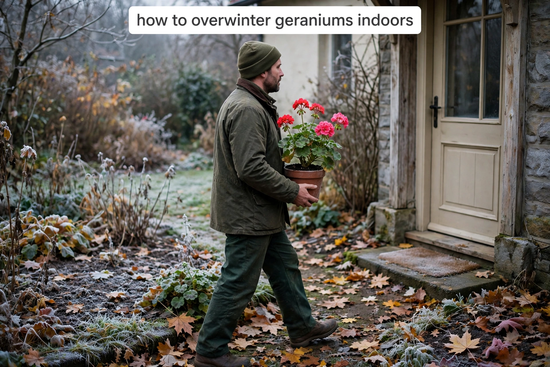
Overwintering geraniums means sheltering frost-tender Pelargonium plants indoors from fall until spring so the same plants, or their cuttings, return to the garden the next year.
The bedding geranium is a tender perennial from southern Africa. Cold ends its season, not age.
How to Overwinter Geraniums Indoors in 7 Steps
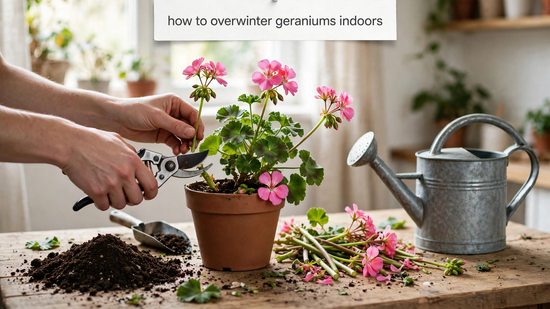
Move healthy plants inside before frost, prune them, and then give them strong light, cool air, and little water until spring. These steps cover the potted-houseplant method.
- Pick your keepers. Choose plants with firm stems and clean leaves. Skip any with gray fuzzy mold (botrytis) or blackened stem bases.
- Check for hitchhikers. Inspect leaf undersides for whiteflies, aphids, and spider mites, hose the foliage, and isolate the plants from other houseplants for two weeks.
- Pot up garden plants. Dig in-ground geraniums with a generous root ball and use a pot only slightly wider than the roots, with drainage holes and a fresh, fast-draining mix.
- Cut back the top growth. Prune each stem just above a leaf node and remove every flower and bud. The table below gives the recommended amount.
- Claim the brightest window. A south- or west-facing sill works best. Turn the pot a quarter turn weekly so stems grow straight.
- Water only when the top inch of soil is dry. Water deeply, let it drain, and empty the saucer.
- Hold the fertilizer. Once fresh growth appears in late winter, feed at half strength every two weeks and pinch tips to encourage branching.
Light is the step most people underestimate. Colorado State University Extension’s El Paso County office calls for at least 10 to 12 hours of light indoors, in a bright south window or under fluorescent lights. If your December sill gets six good hours, run an LED grow light 6 to 12 inches above the leaves for the remaining four to six on an outlet timer.
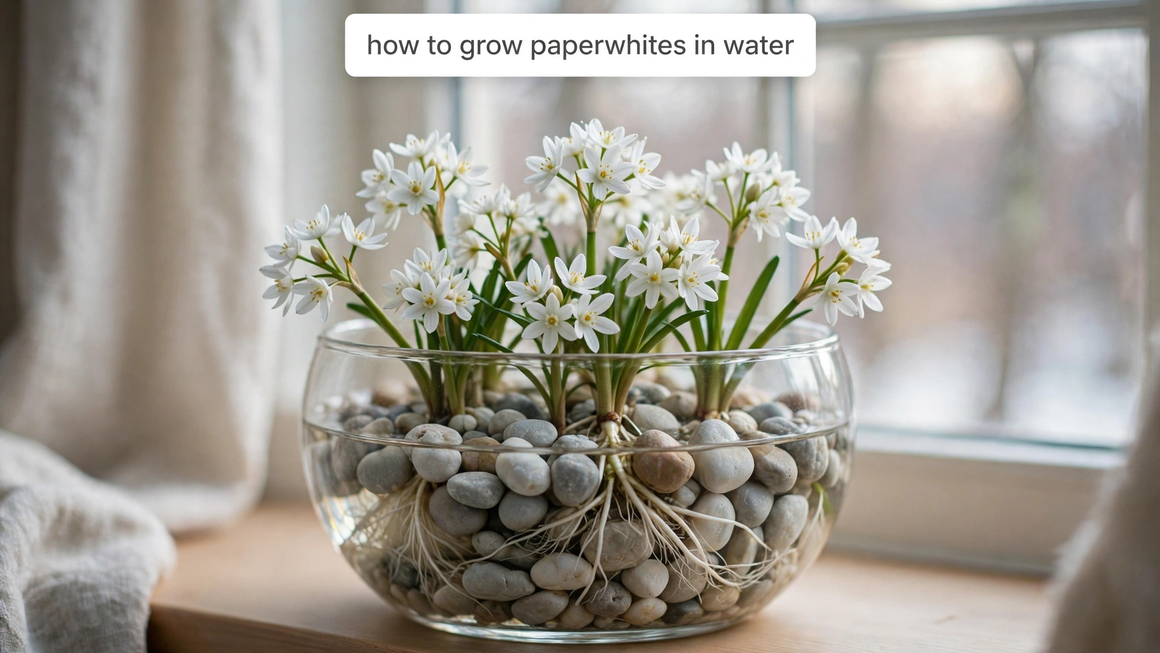
That shelf earns its keep twice. Anyone learning how to grow paperwhites in water can set the bulb bowl beside the geraniums, since both stretch and flop when light runs short.
Which Overwintering Method Fits Your Space?
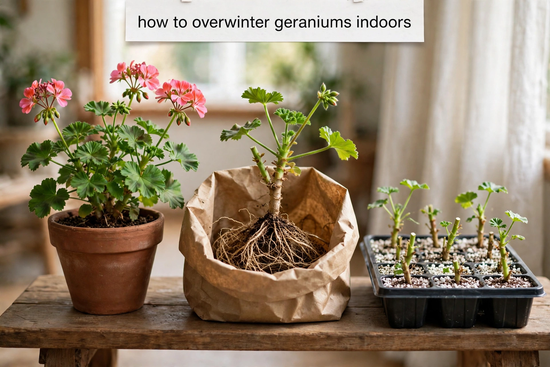
Pot up geraniums if you have a sunny window, store them bare-root if you have a cool basement, and take cuttings if you lack both. Each method trades effort against plant size in spring.
| Stage or method | Best for | Sourced guideline | Source |
| Potted houseplant | A sunny window and a few plants | Trim plants back by one-third to one-half once indoors | University of Wisconsin–Madison Division of Extension |
| Bare-root dormant storage | A cool basement and many plants | Hang plants upside down in a dark spot at 45–50°F with low humidity | Purdue University Extension |
| Stem cuttings | Tight space or limited light | Cut 3–4 inch sections from stem tips | University of Wisconsin–Madison Division of Extension |
| Potting rooted cuttings | Cuttings with established roots | Move each rooted cutting into a 3–4 inch pot | University of Illinois Extension |
| Late-winter pruning | Leggy or dormant plants | Cut plants back by one-half to two-thirds in March | Iowa State University Extension and Outreach |
| Return outdoors | All three methods | Move plants outside in May | University of Illinois Extension |
The two pruning figures measure different moments. The fall trim stays light so the plant keeps leaves while it adjusts; the late-winter cut goes harder to remove weak, low-light growth.
How do you store geraniums bare-root?
Shake all soil off the roots, then hang the plants or stand them in open paper bags somewhere cool, dark, and dry. Once a month, soak the roots in water for 1 to 2 hours, and discard any plants with shriveled stems. In mid-March, pot them up, water once, and move them into bright light, then plant them outdoors in May after the last frost.
How do you root geranium cuttings?
Take non-flowering stem tips, strip the lower leaves, and let the cut end dry for a few hours. Dip it in rooting hormone, stick it in damp perlite, and leave it uncovered in bright, indirect light. Geranium cuttings rot more often than they wilt, so skip the humidity dome.
Before cutting, sketch where each plant will go when you design a garden layout for spring, so you know whether you need six cuttings or sixty. In 2025, U.S. household gardening spending hit a record $79.0 billion, 13.5% above 2024, according to the National Gardening Association’s National Gardening Survey 2026 Edition. That works out to roughly $9.4 billion more in a single year, so one mother plant with twelve healthy tips, yielding twelve free plants, is a real saving.
How Much Light and Warmth Do Geraniums Need Indoors?
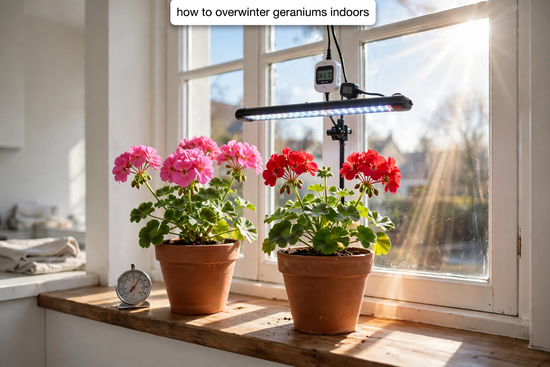
Geraniums need full, direct sun and cool nights indoors. Warm, dim rooms produce thin stems and few flowers.
Purdue University Extension puts the best night temperature for indoor geraniums at 55 to 60°F and links warmer homes to spindly growth. A house held at 68°F overnight runs 8 to 13 degrees too warm. Move pots to an unheated spare room or an enclosed porch that stays above freezing, away from heat registers. That range covers actively growing plants; dormant bare-root plants need the colder storage in the table.
Geraniums sit at the opposite end of the light scale from the best indoor plants that survive without direct sunlight, such as snake plants, ZZ plants, and pothos. Give those the dim corners and reserve every sunny pane for geraniums.
Why Do Indoor Geraniums Get Leggy, and How Do You Fix It?
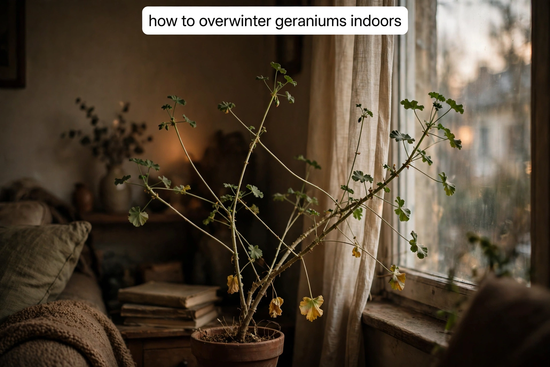
Indoor geraniums get leggy when warmth pushes growth faster than winter light supports. The fix is cooler nights, more light, and a hard prune.
The mistake starts with good intentions. People park geraniums in the warmest room, stems lean toward the glass, gaps between leaves double or triple, and lower leaves drop.
Holiday plants make the error easy. Part of how to keep poinsettias alive after Christmas is a warm, draft-free room, and gardeners often set geraniums right beside them. Split them up: poinsettias get the cozy living room, and geraniums get the chilly bright window.
Read the leaves before acting:
- Yellowing all over with wet soil means too much water.
- Yellow lower leaves with long, pale stems mean too little light.
- Red-tinged leaves signal cold stress, fixed by a slightly warmer spot.
When Should Geraniums Go Back Outside?
Move geraniums outdoors after your last spring frost, once nights stay above about 50°F. Harden them off over 7 to 10 days, starting in shade.
Iowa State University Extension and Outreach expects geranium cuttings to root in 6 to 8 weeks. Cuttings taken September 15 root between October 27 and November 10, leaving about six months of growth before a mid-May planting, enough for a bushy, budded plant.
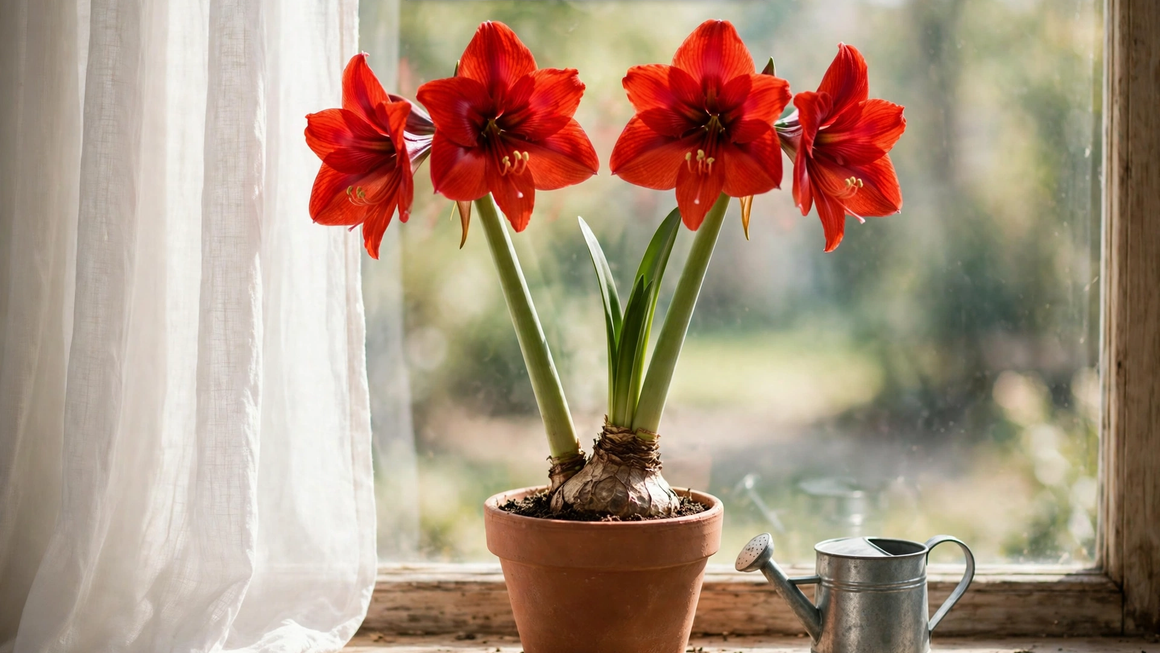
Other tender plants share the calendar. Gardeners who learned how to grow amaryllis bulbs indoors for holiday blooms can move those pots out the same day, where summer sun rebuilds the bulb for next winter.
When Does This Advice Not Apply?
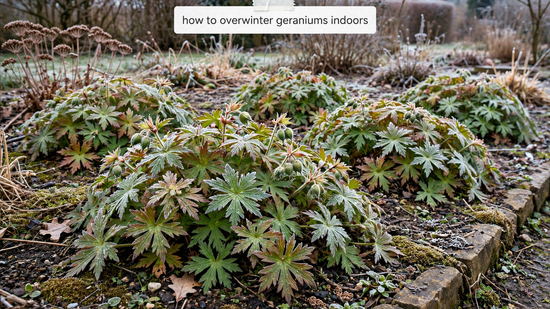
Hardy geraniums, such as bloody cranesbill and ‘Rozanne,’ belong to a different genus (Geranium) and stay in the ground all winter, so digging them up does harm. In frost-free areas like coastal Southern California and South Florida, Pelargonium stays outdoors year-round. Ivy and scented geraniums handle bare-root storage less reliably than zonal types, so keep them as houseplants or cuttings.
Frequently Asked Questions
Can you overwinter geraniums in a garage?
Yes, if the garage stays above freezing and you store the plants dormant and bare-root. An attached garage holds temperature better than a detached one.
How often should you water geraniums indoors in winter?
Water indoor geraniums only when the top inch of mix feels dry, usually every 10 to 14 days in a cool room. Clay pots and warm rooms dry faster.
Do geraniums need to be cut back before bringing them inside?
Yes, cutting geraniums back reduces water loss and saves window space. Leave several leaf nodes on each stem for new shoots.
Can geranium cuttings root in water?
Yes, geranium cuttings root in water, but those roots are fragile and adjust poorly to soil. Damp perlite grows sturdier roots.
Why are my overwintered geraniums turning yellow?
Yellow leaves usually point to overwatering or low light. Some leaf drop in the first two weeks indoors is a normal adjustment.
Conclusion
Knowing how to overwinter geraniums indoors means one sunny window, a cool room, and a light hand with water can carry a whole bed of plants into next summer. Pick the method that fits your space, prune hard in late winter, and replant after the last frost for bigger, earlier blooms.