
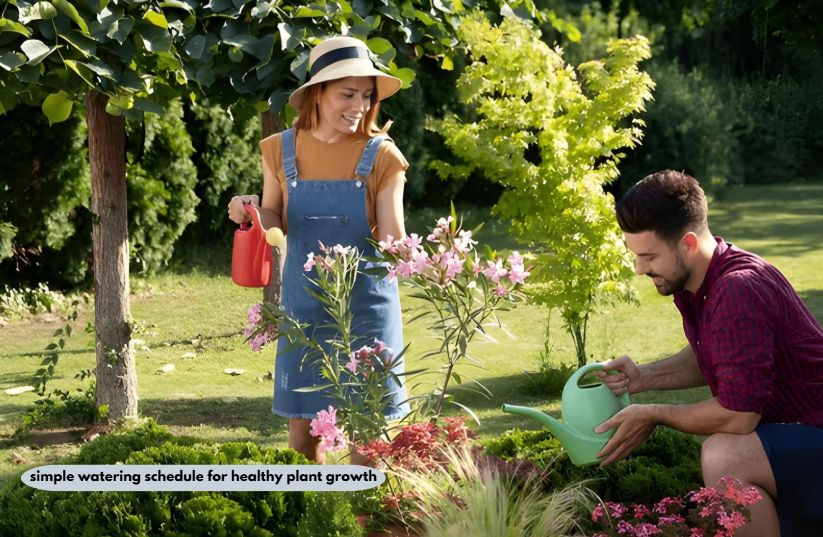
A simple watering schedule for healthy plant growth gives in-ground beds about 1 inch of water a week, split into two deep morning sessions instead of daily sprinkles. Check the soil 2 inches down before each session, subtract any rainfall, and water only when that layer feels dry.
Key Takeaways
- Established in-ground plants do best when rain and irrigation together supply about an inch of water every week.
- One inch of water equals about 0.62 gallons for every square foot of bed.
- Two deep sessions a week grow deeper roots than a light sprinkle every day.
- Watering in the early morning means less water evaporates, and the leaves have time to dry out before evening.
- Potted plants, freshly transplanted ones, and plants in sandy soil all need watering more frequently than the usual schedule calls for.
What is a watering schedule?
A watering schedule is a repeating plan that sets how much water each planted area receives, on which days, and at what time, adjusted for rainfall and soil.
How much water do garden plants need each week?
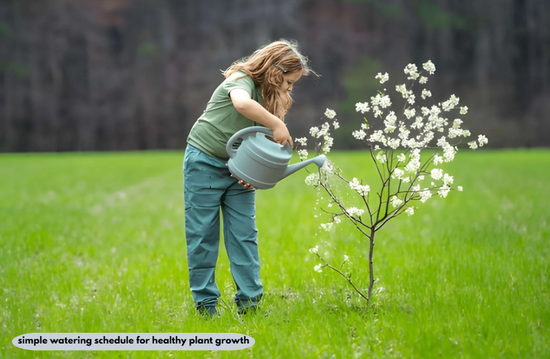
Most established plants in the ground need one steady weekly soaking amount, and that amount is easy to convert into gallons. The weekly target for established beds is about an inch of water, rain included, which works out to 0.62 gallons for each square foot, according to a July 2026 watering guide from the UConn Home Garden Education Office.
A standard 4 × 8 foot raised bed covers 32 square feet, so it needs about 20 gallons a week. That is four full 5-gallon buckets, not the quick pass with a hose that most beds get.
How do I turn 1 inch of water into hose minutes?
Time your hose once with a bucket, and every future watering becomes a number of minutes. Follow these steps:
- Measure the bed and multiply length by width. A 4 × 8 foot bed is 32 square feet.
- Multiply the area by 0.62. For 32 square feet, the result is 19.8, or about 20 gallons a week.
- Time how long your hose takes to fill a 5-gallon bucket. A fill time of 2 minutes 30 seconds means a flow of 2 gallons per minute.
- Divide weekly gallons by flow. Twenty gallons at 2 gallons per minute is 10 minutes of watering a week.
- Split the total into two sessions of 5 minutes each.
- Subtract rain. If the gauge shows 0.4 inches for the week, the bed needs only 0.6 inch, which is 12 gallons or 6 minutes.
The table applies the same math to common bed sizes at a flow of 2 gallons per minute.
| Planted area | Weekly water | Weekly hose time | Sessions | Source |
| One 4 × 8 ft raised bed (32 sq ft) | 20 gallons | 10 minutes | 2 × 5 minutes | Calculated at 0.62 gallons per sq ft |
| Two 4 × 8 ft raised beds (64 sq ft) | 40 gallons | 20 minutes | 2 × 10 minutes | Calculated at 0.62 gallons per sq ft |
| 10 × 12 ft plot (120 sq ft) | 74 gallons | 37 minutes | 2 × 18 to 19 minutes | Calculated at 0.62 gallons per sq ft |
| 12 × 20 ft plot (240 sq ft) | 149 gallons | 74 minutes | 2 × 37 minutes | Calculated at 0.62 gallons per sq ft |
| Sandy soil, per 100 sq ft | 62 gallons (31 per session) | 31 minutes | 2 × 15 to 16 minutes | University of Minnesota Extension |
What is a simple watering schedule for healthy plant growth?
Plan on watering deeply twice a week in the morning, checking the soil before each session. Follow this weekly routine for garden beds from late spring until early fall:
- Tuesday, before 9 a.m.: Push a finger 2 inches into the soil. If it is dry, apply half the weekly amount at the base of the plants.
- Saturday, before 9 a.m.: Read the rain gauge, subtract the week’s rainfall, and apply what is left.
- Any day above 90°F: Check containers and new plantings in the late afternoon and water the ones that are dry.
A 2- to 3-inch layer of mulch slows evaporation and keeps the soil moist between sessions.
What is the most common watering mistake?
The most common mistake is a light sprinkle every day. It happens because the soil surface looks dry by mid-afternoon, so watering feels overdue even when the root zone is still moist.
A daily sprinkle wets only the top inch. Roots stay near the surface, where soil heats and dries fastest, so the plant wilts sooner and demands even more water.
To fix this, water gently at the base of the plant until the soil is moist 6 inches down, then hold off until the top 2 inches have dried. Dig a small hole with a trowel an hour after watering to confirm the depth.
Does a watering schedule save water?
Yes, a schedule cuts waste because it replaces guesswork with a measured weekly amount. A typical U.S. home goes through 320 gallons of water daily, sends roughly 30 percent of it outdoors, and loses up to half of that outdoor share to inefficient watering, according to the U.S. Environmental Protection Agency’s WaterSense program.
That works out to 96 gallons outdoors each day and up to 48 gallons wasted, or about 1,440 gallons over a 30-day month. Those numbers describe what households actually use, while the inch-a-week target describes what plants need. The gap between the two is the water a schedule keeps in the tap.
How should a garden be laid out to make watering easier?
Group plants by how much water they need, and keep the thirstiest ones within one hose length of the spigot. This single decision makes the two-session schedule easier to follow than anything else in this guide. Homeowners who wonder “can I design my own garden” will find that graph paper, a tape measure, and 20 minutes are enough to do it.
Three zones, starting from the spigot
When you design a garden layoutfor easy watering, mark the spigot on your sketch first and work outward:
- Closest to the spigot: vegetables, containers, and new transplants, since they need water most often.
- Middle: shrubs and established perennials on the standard inch-a-week schedule.
- Far edge: drought-tolerant natives that need little or no extra water.
A common mistake when designing gardens for the first time is mixing thirsty and dry-loving plants in one bed, which leaves one group getting the wrong amount whatever you do. Separate zones let each area follow its own schedule.
Three low-cost upgrades
Among modern small garden ideas on budget,, three improve watering the most: a soaker hose laid under mulch, which puts water at the roots with almost no evaporation; a plastic rain gauge, which tells you exactly how much to subtract each week; and a mechanical faucet timer, which shuts the water off on time. The same three belong on any list of yard makeover ideas, because they work in a bed of any size and cost little.
Seating and the low-water zone
Place outdoor living areas such as patios and fire pits beside the low-water zone. Seating stays dry, and hoses never have to cross walkways.
Does a regular watering routine reduce stress?
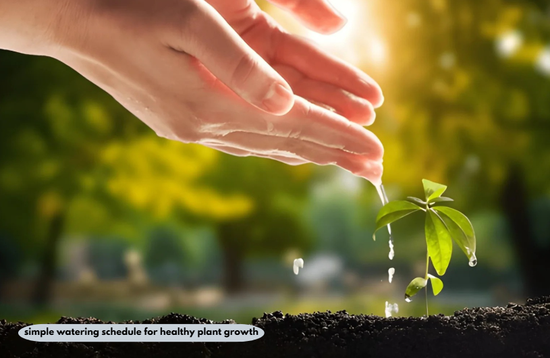
Yes, a short and predictable garden task provides regular time outdoors with a clear finish. Research on how gardening affects mental health points in the same direction.
A 2022 University of Florida study of 32 women found that gardening twice a week left them feeling less stressed, anxious, and depressed. A two-session watering week follows the same rhythm, so treat Tuesday and Saturday mornings as 10 phone-free minutes with the hose.
When does the 1-inch rule not apply?
The 1-inch rule does not fit containers, new transplants, heavy clay, or areas under watering restrictions. Pots hold little soil and need a daily finger check in summer, while transplants need water every one to two days for their first two weeks. Clay holds moisture longer, so one deep session a week is enough, and local drought rules on watering days override any schedule.
Frequently Asked Questions
What is the best time of day to water plants?
The ideal time to water plants is early in the morning, roughly from 5 to 9 a.m. Cooler air and lighter wind mean less water evaporates, and wet leaves dry quickly once the sun is up. Evening watering is the next-best option, as long as you aim the water at the soil rather than the leaves.
How do I know if I am overwatering my plants?
Overwatered plants show yellowing lower leaves, soft stems, and soil that stays wet for days. Stop watering until the top 2 inches dry out.
Should I water my garden every day?
No, most in-ground gardens grow better with two deep waterings a week than with daily watering. Daily water is right only for containers, seed beds, and new transplants, which dry out much faster.
How long should I run a soaker hose?
Run a soaker hose until a trowel shows moist soil 6 inches deep, then record that time and reuse it. Flow changes with water pressure and hose length, so one test on your own bed is more accurate than a general number.
Do I still need to water after it rains?
You need to water after rain only if the gauge shows less than 1 inch for the week. A brief shower often wets just the surface. Subtract the rainfall from 1 inch and supply the difference at the next session.
Conclusion
A simple watering schedule for healthy plant growth comes down to one number and two mornings: about an inch a week, delivered in two deep sessions. Measure the bed and time the hose once, and the math never has to be repeated. Let the soil, not the calendar, have the final say before every session.


One thought on “Simple Watering Schedule for Healthy Plant Growth: An Easy Guide”