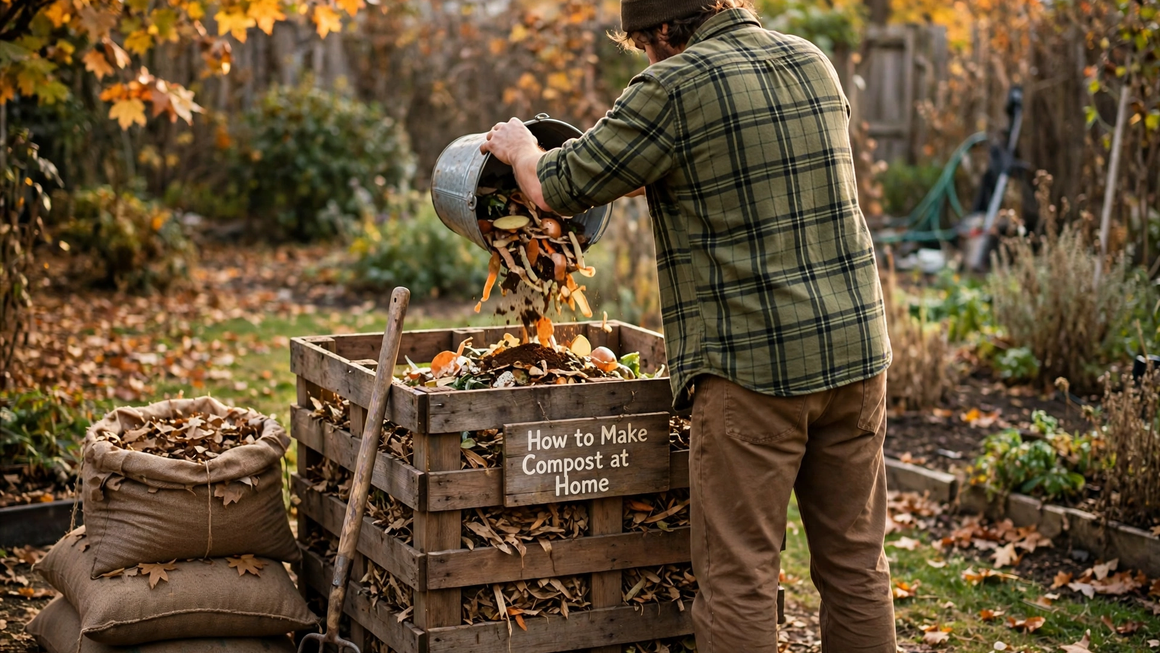
Learning how to make compost at home takes four ingredients: dry browns like leaves, wet greens like food scraps, water, and air. Layer three parts browns to one part greens, keep the pile sponge-damp, turn it every week or two, and harvest finished compost in two to four months (or six to twelve months if you never turn it).
Key Takeaways
- A working compost pile needs carbon-rich browns, nitrogen-rich greens, steady moisture, and regular oxygen.
- A bin about 3 feet wide, deep, and tall holds enough mass to heat up and decompose quickly.
- A bin roughly 3 feet on every side has enough bulk to heat up and break down fast.
- Flip the pile every week or two for faster breakdown and no sour smells.
- Finished compost loosens heavy soil, improves drainage, and feeds plants slowly over a full season.
What Is Compost?
Compost is the dark, crumbly material left behind after bacteria, fungi, and tiny invertebrates digest plant scraps and yard debris, producing a stable amendment that loosens soil and releases nutrients to roots gradually.
How to Make Compost at Home in 8 Steps
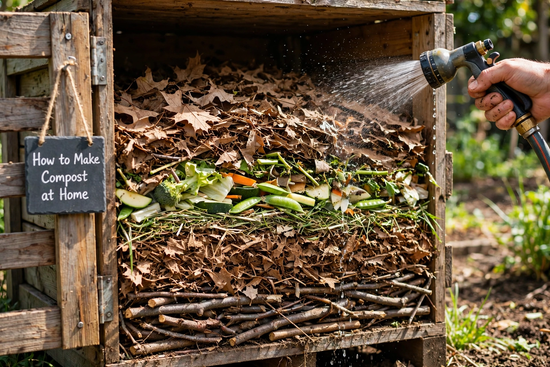
You can build the pile in one afternoon and then maintain it in about ten minutes a week. The sequence works for an open heap, a pallet bin, or a store-bought tumbler.
- Pick a level, well-drained spot in partial shade, close enough to a hose that watering never becomes a chore.
- Set up a bin roughly 3 feet wide, 3 feet deep, and 3 feet tall. Smaller piles lose heat overnight, and much larger ones starve their own core of air.
- Spread 4 to 6 inches of coarse stems or twigs across the bottom so air rises into the pile.
- Add a 6-inch layer of shredded leaves, then a 2-inch layer of greens such as vegetable peels, coffee grounds, or fresh grass clippings.
- Sprinkle each layer until a squeezed handful releases one or two drops of water.
- Repeat the layers until the bin is full, finishing with browns on top to hide food from fruit flies.
- Turn everything with a pitchfork every 7 to 14 days, moving the dry outer edges into the hot center.
- Once the bin fills, stop feeding it. Start a second pile beside it so the first one finishes on schedule.
Should You Choose Hot or Cold Composting?
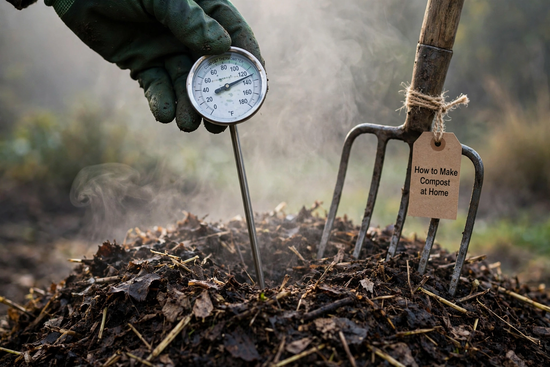
Pick hot composting if you want finished compost within a few months and fewer surviving weed seeds. Pick cold composting if you’d rather toss in material whenever it shows up and wait six to twelve months or longer.
Turning makes the difference. University of Georgia Cooperative Extension sets the active-phase target for a hot pile at 131 to 160°F, so push a long-stem compost thermometer 12 inches into the center every few days. When the reading falls below 100°F, turn the pile to restart the heat. Cold piles never get that hot, so keep seeding weeds and diseased plants out of them entirely.
| Hot composting | Cold composting | |
| Time to finish | 2–4 months | 6–12+ months |
| Effort | Turn every 7–14 days | Little to none |
| Kills weed seeds | Mostly | No |
| Best for | Fast results, big gardens | Busy or casual gardeners |
What Can You Put in a Compost Pile?
Raw fruit and vegetable scraps, coffee grounds, eggshells, leaves, straw, plain cardboard, and uncoated paper all break down well. Meat, bones, cheese, cooking oil, diseased plants, seeding weeds, and cat or dog waste stay out because they draw rodents, smell, or carry pathogens a backyard pile won’t reliably kill.
Free materials make compost the foundation of a cheap garden. Neighbors bag leaves every fall, many coffee shops hand out spent grounds on request, and local tree crews often drop off wood chips at no charge.
Fireplace ash sits in a gray zone. University of Nebraska–Lincoln Extension pegs wood ash at about 25 percent calcium carbonate, the same compound sold as garden lime. Dust it thinly over a layer at most, and skip it entirely if your soil test already reads above pH 7.
What Is the Right Ratio of Greens to Browns?
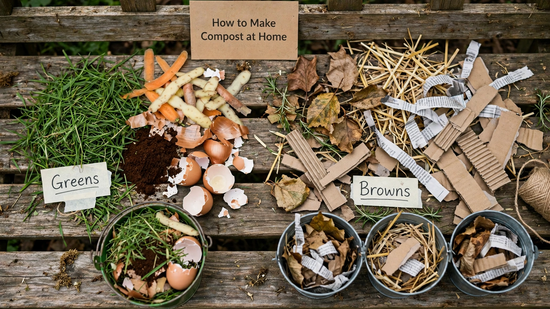
Aim for about three buckets of browns for every bucket of greens, measured by volume. Greens are moist and nitrogen-heavy, and browns are dry and carbon-heavy.
The microbes in your pile eat best at a carbon-to-nitrogen ratio of roughly 30:1 by weight, according to Cornell University’s Cornell Waste Management Institute. No common scrap hits that target alone, so pair low-ratio greens with high-ratio browns from the table below.
| Material | Type | Approx. C:N ratio | Source |
| Food waste | Green | 15:1 | Cornell Waste Management Institute |
| Grass clippings | Green | 19:1 | Cornell Waste Management Institute |
| Coffee grounds | Green | 20:1 | University of Nebraska–Lincoln Extension |
| Leaves | Brown | 40–80:1 | Cornell Waste Management Institute |
| Straw | Brown | 80:1 | Texas A&M AgriLife Extension |
| Shredded newspaper | Brown | 400–800:1 | University of Nebraska–Lincoln Extension |
Paper is the strongest brown per handful, so shred it and use it sparingly. Leaves are the most forgiving choice for beginners.
End-of-season cleanup feeds the pile too. If you’re already growing some of the best vegetables to grow at home like tomatoes, beans, and squash, their spent vines and leaves go straight back into the pile: they count as greens while fresh and as browns once they dry.
How Much Material Goes In, and How Much Compost Comes Out?
A household that fills one gallon of scraps every two days needs about 14 large bags of shredded leaves a year, and one full bin yields enough finished compost for a single raised bed. Both numbers come from simple math.
Here is the input side, using the 3:1 volume rule:
- Kitchen scraps: 1 gallon every 2 days equals 3.5 gallons per week.
- Browns needed: 3.5 × 3 equals 10.5 gallons per week.
- Yearly browns: 10.5 × 52 equals 546 gallons, or about 73 cubic feet.
- Storage: 546 gallons ÷ 39-gallon contractor bags equals 14 bags.
Rake and shred leaves in October and November, bag them, and stack them beside the bin. Every time you empty the scrap bucket, cover it with three buckets from that leaf bank.
On the output side, a full 27-cubic-foot bin usually settles to around half its starting volume, depending on its materials and how often you turn it. That leaves roughly 13 cubic feet. That’s perfect timing, because the best soil for raised garden beds is a loose mix of about two-thirds screened topsoil and one-third compost. A 4-by-8-foot bed filled 12 inches deep (32 cubic feet) needs about 10.7 cubic feet of compost, with a little left over for top-dressing.
Your scrap bucket also shows how much food you waste. The U.S. EPA estimates the average American loses $728 a year to wasted food, so if moldy leftovers outnumber peels and cores, adjust your shopping list.
Why Does My Compost Smell Bad or Stay Cold?
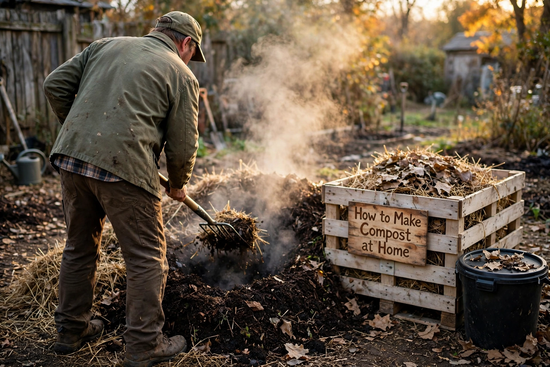
A sour or ammonia smell means too many greens and too little air, while a cold pile usually lacks nitrogen, moisture, or volume. Every one of these problems has a same-day fix.
- Ammonia smell: Mix in dry leaves and turn the pile.
- Rotten-egg smell: The pile is waterlogged. Turn it, add coarse browns like straw, and cover it during heavy rain.
- No heat: Build the pile to a full 3-foot size, water it, and add a fresh layer of grass or scraps.
- Too dry or not breaking down: Water the pile while turning it until a squeezed handful releases one or two drops, then cover it to hold moisture.
- Fruit flies: Bury fresh food 8 inches into the center instead of dumping it on top.
The most common beginner mistake is treating the bin like a kitchen trash can. It happens because scraps pile up daily while leaves fall only once a year. Stockpile browns in autumn, keep a lidded bucket of them next to the bin, and the pile stays balanced through July.
How Do You Use Homemade Compost in Your Garden?
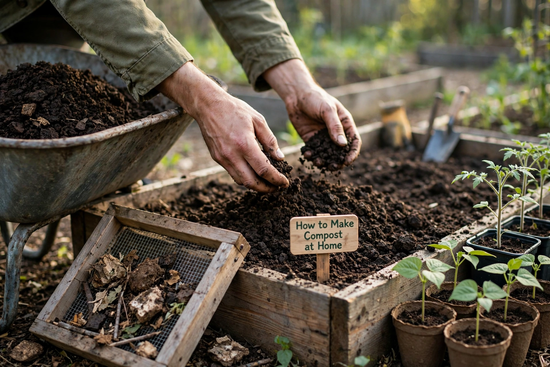
Work 2 to 3 inches into beds before planting, spread a half-inch top-dressing around established plants, or rake a quarter-inch layer over the lawn in early fall. Screen out unfinished chunks and toss them back into the active pile.
If you’ve been looking into how to fix clay soil for gardening, compost is the most reliable answer. It binds fine clay particles into larger crumbs, which opens space for water and roots. Repeat a 2-to-3-inch application every spring and fall for two or three years, and never add sand, which turns clay into something close to concrete.
Timing matters as much as quantity. Spread compost two to three weeks before planting so it settles, and keep fresh, unfinished material away from seedlings, since active decomposition ties up nitrogen the young roots need.
One exception overrides the advice above: grass clippings, hay, straw, or manure that came from ground treated with persistent herbicides such as clopyralid or aminopyralid. These chemicals survive composting and can twist and stunt tomatoes, beans, and peppers even at trace levels. If a lawn service sprays your yard for broadleaf weeds, or you can’t confirm how a farm managed its hay, keep that material out of any pile headed for vegetable beds.
Frequently Asked Questions
How long does it take to make compost?
A balanced pile that you turn regularly finishes in two to four months of warm weather, while an untouched pile takes six to twelve months. It’s ready when it looks dark and crumbly and smells like a forest floor, and the center stays cool after turning.
Can you make compost without a yard?
Yes, an indoor worm bin or a sealed bokashi bucket handles kitchen scraps in an apartment. Red wiggler worms process vegetable waste in a plastic tote under the sink. Bokashi ferments scraps, which you then bury in a planter or take to a community drop-off.
Do you need to add worms to a compost pile?
No, an outdoor pile sitting on bare soil attracts earthworms, insects, and microbes on its own. Buying worms only makes sense for indoor vermicomposting bins.
Does a compost pile attract rats?
Rodents show up mainly when a pile holds meat, dairy, greasy food, or scraps left exposed on top. Line the bin floor with half-inch hardware cloth, bury fresh food deep in the center, and cover every addition with browns.
Can you compost in the winter?
Yes, you can keep adding scraps all winter, although decomposition nearly stops once the pile freezes. Cover each deposit with stored leaves, and the pile will reheat quickly when spring temperatures climb.
What is the cheapest way to start composting?
An open pile or a hoop of leftover wire fencing costs little or nothing to set up. Three or four shipping pallets wired together at the corners make a sturdy bin, and you don’t need a tumbler until you know you’ll stick with it.
Conclusion
Knowing how to make compost at home turns kitchen scraps and fall leaves into the most useful amendment a vegetable garden can get. Balance browns and greens, keep the pile damp and airy, and a 3-foot bin will repay ten minutes of weekly work with free, living soil.


One thought on “How to Make Compost at Home: 8 Easy Steps for Beginners ”