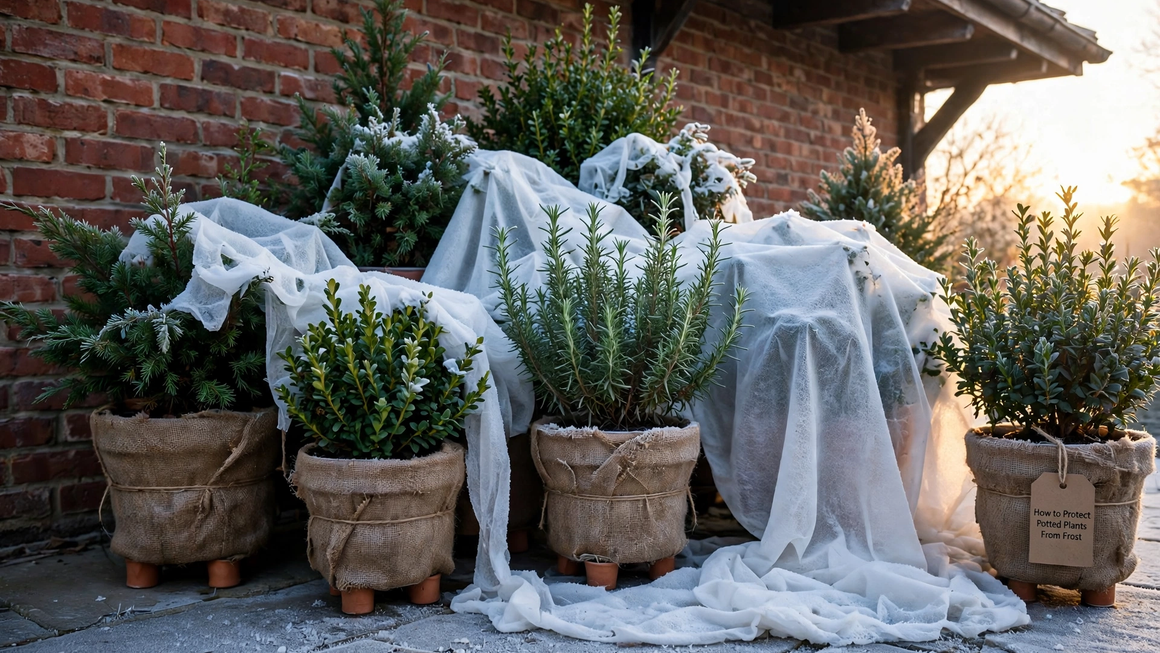
Knowing how to protect potted plants from frost starts with the roots: group pots tightly against a house wall, wrap or bury the containers, and cover foliage with heavyweight frost cloth before sunset. Bring tender plants indoors, water a day ahead of a freeze, and lift pots off cold pavement.
Key Takeaways
- Roots in a container tolerate far less cold than the stems and leaves above them, so the root ball needs protection first.
- Potting mix in an above-ground pot cools to nearly the air temperature on a freezing night, while garden soil stays much warmer.
- Heavyweight frost cloth that reaches the ground traps the heat rising from the soil, while lightweight insect fabric gives almost no frost protection.
- Pushing nine 12-inch pots into one tight block and wrapping them together cuts their exposed sidewall area by about 58%.
- Frost-tender plants such as tomatoes, citrus, and hibiscus need indoor shelter because outdoor wrapping won’t protect them.
What Is Frost Damage in Potted Plants?
Frost damage in potted plants is injury caused when ice crystals form inside leaves, stems, or roots, and in containers it usually starts in the root ball because nothing insulates the sides of the pot.
Why Do Potted Plants Freeze Faster Than Garden Plants?
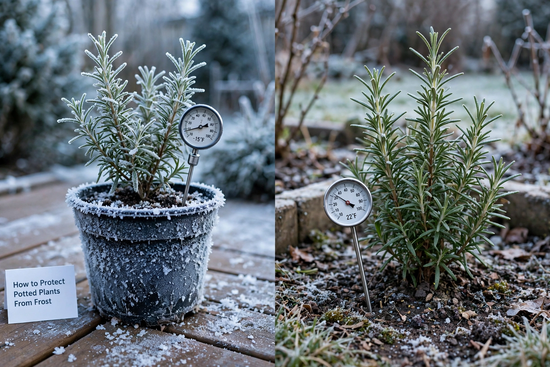
Potted plants freeze faster because cold air hits every side of the container, not just the top. A garden bed wraps roots in a deep mass of earth, while a pot gives them only a thin plastic or clay wall.
Measurements back this up. Iowa State University Extension compared air and soil readings on the coldest days of January and February 2025, when air fell to -15°F or lower, and found the soil 4 inches down averaged about 37°F warmer than the air. On a -15°F night, that buffer leaves garden roots near 22°F. A pot on a deck gets none of it, so its roots face almost the full -15°F.
Roots also never harden off as much as the branches above them. A good guide on how to grow vegetables at home in pots for beginners will get your plants through the growing season, but winter is where container growers get caught out. Potted thyme often dies over winter while the same thyme in a bed comes back each spring, and the difference is the soil around its roots.
How to Protect Potted Plants From Frost: 9 Practical Tips
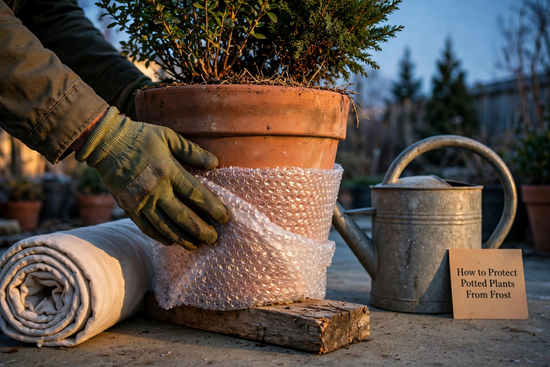
Protect the root ball first and the foliage second, and time each step to the forecast. The tips below start with the cheapest and get more involved as you go.
- Watch the overnight low. From October on, check the forecast for low and wind speed each evening. Start protecting a plant when the forecast comes within 5°F of its root-kill temperature, which is listed in the table below.
- Park pots against the house. A south- or east-facing masonry wall gives off stored daytime heat after dark, and the roof eave above it cuts heat loss to the open sky.
- Cluster containers. Put the hardiest plants on the outside and the tender ones in the middle, then pack shredded leaves into the gaps.
- Get pots off the concrete. Frozen pavement pulls heat out through the base of the pot. Set pots on pot feet or a scrap 2×4 so a 1-inch air gap also keeps the drainage holes from icing shut.
- Wrap the container, not just the plant. Use two layers of bubble wrap, or burlap stuffed with straw, from the soil line down to the base. One layer around a 12-inch pot takes about 38 inches of wrap, plus a 4-inch overlap.
- Water a day or two before the freeze. Moist potting mix holds more heat than dry mix and releases it slowly overnight. Skip this step if the mix is already frozen.
- Drape frost cloth all the way to the ground. According to University of Maryland Extension, heavyweight row cover (1.5 to 2.2 ounces per square yard) gives up to 8°F of frost protection. Before a 24°F night, that gap is worth paying for, so buy the heavy grade instead of the thin insect barrier, and pull the cover off once mornings climb above freezing.
- Bury hardy pots. Dig a hole as deep as the pot in an empty bed, sink the pot to its rim, and top it with 3 to 4 inches of shredded bark.
- Move tender plants under cover. An unheated attached garage works for dormant shrubs, while tropicals need a bright room. If you followed advice on how to grow tomatoes in pots this summer, harvest the green fruit before the first frost kills the vines, and let it ripen on the counter.
How Cold Is Too Cold for Container Plant Roots?
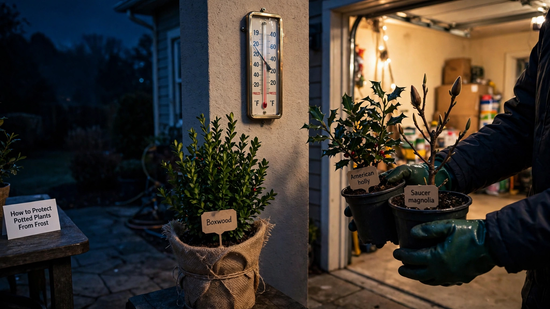
It depends on the species, and the cutoff is much warmer than the zone rating on the plant tag suggests. The roots of several popular landscape shrubs die at temperatures that even a mild winter reaches.
| Plant | Root-kill temperature (°F) | Start protecting at forecast low (°F) | Source |
| Saucer magnolia | 23 | 28 | UMass Extension |
| American holly | 20 | 25 | UMass Extension |
| Common boxwood | 15 | 20 | UMass Extension |
| Bloodleaf Japanese maple | 14 | 19 | UMass Extension |
| Creeping juniper | 0 | 5 | UMass Extension |
| P.J.M. rhododendron | -10 | -5 | UMass Extension |
The root-kill temperature is the warmest temperature that killed more than half of a plant’s root system in testing. The third column adds a 5°F safety margin.
Worked example: Suppose the forecast calls for 19°F on Thursday night. That’s 1°F past the boxwood’s trigger, so wrap its pot that evening. It’s also colder than the root-kill temperature of both the holly (20°F) and the magnolia (23°F), so wrapping isn’t enough for those two. Move them into the garage for the night.
Shopping for new container shrubs works the same way. Whether your plant list comes from landscape ideas from Morph or a nursery catalog, pick species from the last two rows of the table, such as creeping juniper and P.J.M. rhododendron.
When should you wrap pots for the whole season?
Wait until the plants have gone fully dormant, usually several weeks after the first fall frost. UMass Extension’s guidance for overwintering nursery plants times winter covers to 30 or 45 days after the frost date. If your first frost lands on October 25, that puts season-long wrapping between November 24 and December 9. Wrapping earlier traps warmth and keeps plants growing when they should be shutting down.
Does Grouping Pots Together Actually Help?
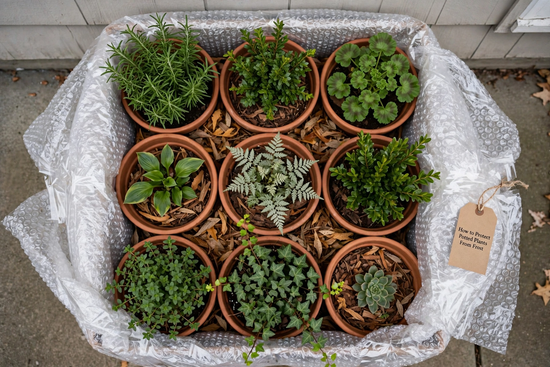
Yes. Grouping shrinks the amount of container wall exposed to cold air, so each pot loses heat more slowly.
Here’s the math. A pot 12 inches wide and 12 inches tall has about 452 square inches of sidewall (π × 12 × 12), so nine pots standing apart expose roughly 4,070 square inches. Pushed into a 3-by-3 block and wrapped as one unit, they form a 36-inch square with a 144-inch perimeter. At 12 inches tall, that leaves 1,728 square inches facing the air, about 58% less.
Wrapping the block also saves material: about 148 inches of bubble wrap, overlap included, instead of roughly 378 for nine separate pots. The center pot ends up fully surrounded, so give it your most tender plant.
Plan the spot ahead of time. When you design a garden layout for next season, set aside a sheltered nook beside the house as winter parking for containers, with enough room for a 3-by-3 block.
Which Pots Survive Freezing Weather Best?
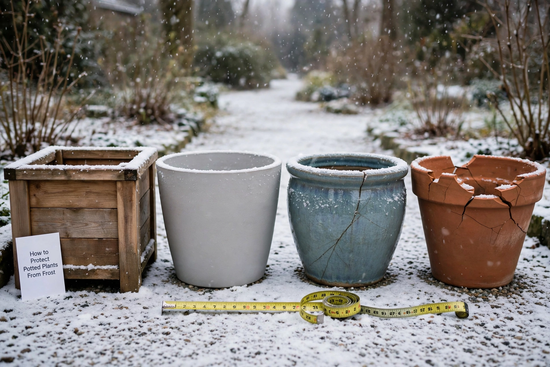
Pots with thick walls that don’t absorb water hold up best, and bigger pots protect roots better than small ones. Fiberglass, thick resin, and cedar planters handle repeated freezing and thawing without cracking.
Terra cotta and low-fired ceramic soak up water through their walls. When that water freezes, it expands and splits the pot, often along the rim. Glazed ceramic cracks too when water collects under the glaze or in a saucer beneath it. Thin plastic flexes instead of breaking, but it barely insulates.
Size matters more than most people expect. An 18-inch pot holds about 3.4 times the soil of a 12-inch pot of the same shape, since volume grows with the cube of the width, while its wall area grows only about 2.3 times. More soil for each square inch of wall means the root ball cools more slowly overnight.
Good Garden Design matches a container’s color and shape with a material that suits your climate. In a freezing climate, wall thickness and material decide whether the pot and the plant both make it to spring.
How Do You Overwinter Potted Plants Indoors?
Put each plant in the coolest bright spot you have, water less, and check for pests before it comes inside. Indoor winter care aims to keep plants alive and resting, not growing.
Start a week before moving day by setting the pots in shade so the leaves adjust to lower indoor light. Rinse the foliage with a hose and look under the leaves for aphids and spider mites. Inside, keep pots away from heating vents and skip fertilizer until new growth appears in late winter.
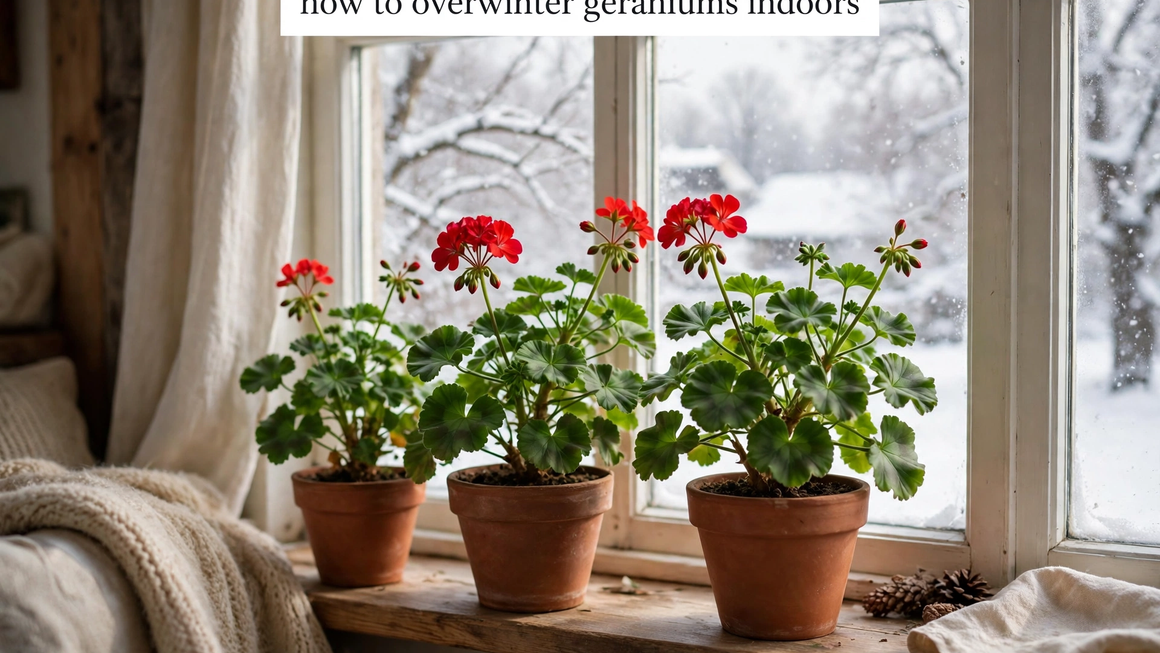
Rosemary, geraniums, and potted peppers on a cool, sunny windowsill make a small indoor garden that carries over to spring. Let the top inch of soil dry out between waterings, because roots in cool rooms rot faster than they dry out.
What Mistakes Kill Potted Plants in Winter?
The most common mistake is trusting the hardiness zone on the plant tag. That rating describes plants growing in the ground, not roots sitting in an exposed pot.
Zone maps have also shifted. According to NPR’s coverage of the November 2023 update, about half the country has shifted into a warmer half zone. A zone is based on an average of past winter lows, not a forecast for any single night, so a potted root ball still feels every January cold snap at close to full strength.
Other mistakes and how to fix them:
- Wrapping only the foliage. Burlap around the branches leaves the roots exposed. Wrap from the soil line down to the base of the pot.
- Laying plastic directly on leaves. Plastic passes cold straight through to the leaves and traps condensation that freezes on them. Use fabric, or build a frame that holds plastic away from the plant.
- Feeding plants in fall. Feeding in September grows tender shoots that the first frost blackens. Stop feeding container shrubs by late summer.
- Storing sun-lovers in a dark basement. Citrus and hibiscus drop their leaves within weeks without light. Save dim corners for the best indoor plants that survive without direct sunlight, such as pothos, ZZ plant, and snake plant, and give the sun-lovers your brightest window.
When Doesn’t the Usual Frost Advice Apply?
Tropical plants and desert succulents are the exceptions. Citrus, hibiscus, and bougainvillea get injured just above freezing, so no outdoor wrap can carry them through a multi-day cold spell. In Gulf Coast areas where a freeze lasts one night, frost cloth over the plant with an incandescent string light underneath works, but LED lights give off almost no heat and won’t help. Desert growers face the opposite risk: cold, wet soil rots cactus roots, so keep those pots dry before a freeze instead of watering them.
Frequently Asked Questions
At what temperature should I cover my potted plants?
Cover most potted plants when the forecast low reaches 32°F, and cover tender species sooner. For hardy shrubs, take each plant’s root-kill temperature and add a 5°F margin. Wind makes a freeze worse, so act a few degrees earlier on breezy nights.
Can I leave potted plants outside all winter?
Yes, if the plant is rated at least two zones colder than yours and its pot is insulated or buried. Small pots under 12 inches wide lose heat fastest, so move those into a garage even when the plant itself is hardy.
Does an old blanket protect potted plants from frost?
A blanket works for one night if it reaches the ground and stays dry. Once it gets wet, it freezes and pulls heat away from the plant. Remove it each morning so the foliage gets light.
Should I water potted plants before a frost?
Yes, water hardy plants one or two days before a hard freeze so the potting mix holds more heat. Skip this for cacti and succulents, and never water a pot whose mix is already frozen.
Is an unheated garage good for overwintering potted plants?
An unheated attached garage is ideal for dormant hardy shrubs because it stays cold but rarely falls to outdoor lows. Check the soil monthly and water lightly when it feels dry. Tropicals need a bright, heated room instead.
Will a frost-damaged potted plant recover?
Many recover if the roots survived, even when the leaves turned black. In early spring, slide the plant out of its pot. If the roots are pale and firm, the plant can still recover; if they are dark and soft, it will not.
Conclusion
The core of how to protect potted plants from frost is simple: guard the root ball, because roots in a pot feel nearly every degree the air does. Group and wrap containers, cover foliage with heavy frost cloth, and bring anything tropical indoors before the first hard freeze.